
Login/Register
Pros & Cons: the Hypothetical Elimination of U.S. Preclearance
Stanis Smith
October 15, 2025
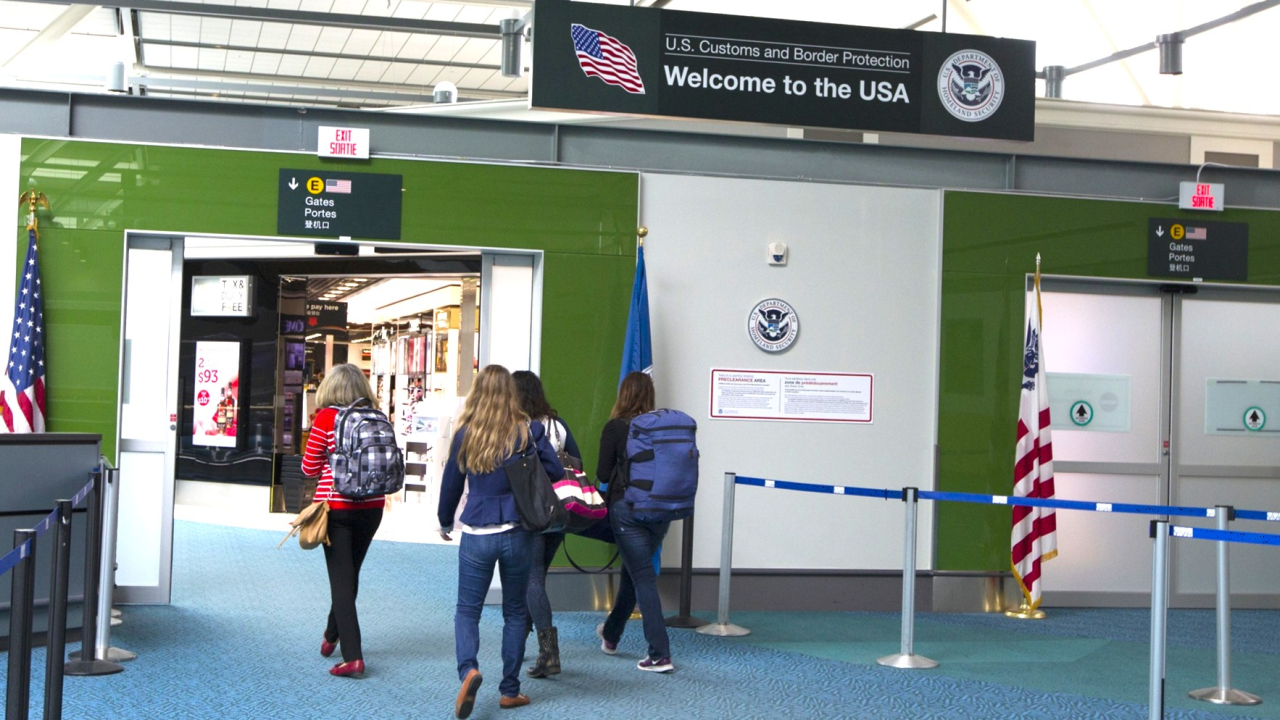
Preclearance at Vancouver Airport.
© Donna Burton / USCBP
Comments by the U.S. Ambassador to Canada have thrust the rather arcane topic of preclearance into the news. Preclearance is the arrangement between the U.S. and Canada (and several other countries) that enables U.S.-bound passengers to clear U.S. Customs and Immigration prior to boarding their flights at select airports in Canada as follows:
- Calgary International Airport,
- Edmonton International Airport,
- Stanfield International Airport (Halifax),
- Trudeau International Airport (Montréal),
- Macdonald-Cartier International Airport (Ottawa),
- Pearson International Airport (Toronto),
- Vancouver International Airport,
- Winnipeg James Armstrong Richardson International Airport, and
- Alaska Marine Highway System Ferry Terminal (Prince Rupert, British Columbia).
Other international U.S. Preclearance locations include:
Ireland
-
Dublin Airport
-
Shannon Airport
Aruba
-
Queen Beatrix International Airport
-
L.F. Wade International Airport
-
Lynden Pindling International Airport (Nassau)
-
Abu Dhabi International Airport
Preclearance has been in place in Canada for far longer than most people realize, with the first trans-border operations launching at Toronto Airport in 1952. Under the authority and control of USCBP (U.S. Customs & Border Protection), preclearance has been facilitated though various treaties, acts and agreements over the subsequent decades.
The preclearance system provides reciprocal benefits:
- Travelers can choose from more U.S. destinations and have a more streamlined arrival process in the U.S. Also, some Canadian airports have benefited from international-U.S. connecting passengers.
- The U.S. has reduced demands on USCBP facilities and staff in its own airports while any ‘problem’ passengers can be handed over to the Canadian authorities without deportation worries.
If preclearance hypothetically disappeared, so would those advantages, however so too would more nuanced aspects of preclearance. What is not well-appreciated is that preclearance facilities make Canadian airport terminals unusually complicated and compromised in ways that are not immediately obvious.
The following examines the facility-related and passenger-related impacts if preclearance were to disappear. It does not include any observations about the airline-related impacts, which may be significant.
We can break down the facility-related and passenger-related impacts as follows:
1. Available Space
Preclearance operations occupy extraordinary amounts of space at Canadian airports including large queuing areas in front of the Primary Line (the kiosks where a passenger’s passport is examined), and there are extensive secondary back-of-house facilities used by USCBP for various purposes.
For example, in one major Canadian airport, USCBP has approximately 40,000 square feet (3,700 sqm) under its control. Elimination of the facility could free up the space for other purposes, potentially retail, food and beverage, and duty-free operations, which could enhance airport revenues and other offerings to passengers.
2. Gate Flexibility
Each aircraft gate and its associated passenger hold room is a major investment, and airport operators want the maximum use from each of their gates as flexibly and quickly as possible. Preclearance reduces that flexibility, because U.S.-bound aircraft can only use a gate where the passengers for that flight have been pre-cleared. Eliminating preclearance will give several Canadian airports significantly more options for gate flexibility.
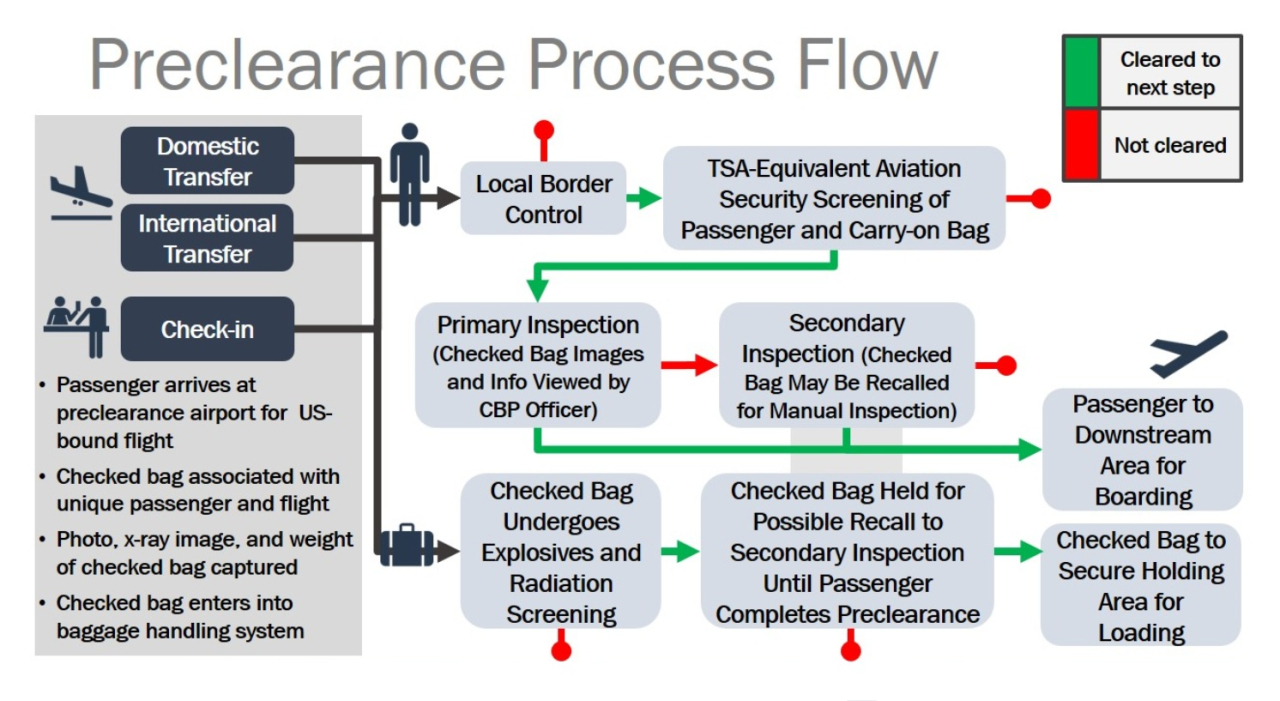
How preclearance works.
© USCBP
3. Passenger Experience
As stated, U.S.-bound passengers are currently screened in Canada and do not have to wait in long lines to go through passport control when they land in the U.S. If preclearance disappeared, Canadians would have to go through USCBP on arrival, along with all the other international arriving passengers, and could experience long line-ups.
Under the current preclearance arrangement, U.S.-bound passengers usually get to Canadian airports earlier than they otherwise would because of the unpredictability of USCBP processing. The total amount of time that preclearance saves across the entire journey is therefore debatable. What is less debatable is that if preclearance disappears, the wayfinding and efficiency of Canadian airports is likely to be enhanced, because all hold rooms will be used for all outbound flights, regardless of destination.
Additionally, there could be more facilities, such as retail, food and beverage, and duty-free offerings, available because currently-segregated U.S. concessions will be accessible to all passengers, and current USCBP spaces could be freed up for additional uses.
4. Security Checkpoints & Baggage Systems
Security checkpoints in Canadian airports are staffed by CATSA, a Canadian agency. However, U.S.-bound passengers must be screened to standards acceptable to TSA, the equivalent U.S. agency. Eliminating preclearance will enable CATSA to staff all checkpoints to the same standards, giving them more flexibility to respond to changes in demand.
In terms of baggage systems, America-bound bags are kept separate from others and screened to TSA standards, thus adding complexity. If preclearance were eliminated, existing systems could be used more flexibly for international and domestic flights.
Concluding Summary
Overall, if preclearance disappeared, the most significant immediate impact would be that certain U.S. airports would become inaccessible for flights from Canada. Perhaps the market would readjust; however, destination options for Canadians would be reduced in the short- to medium-term, and Canadian airports that have benefited from international-U.S. connecting passengers will lose that traffic.
On the flip side, the elimination of preclearance will free up valuable space in Canadian airports and provide greater gate flexibility - this benefit is only valid if such a move is permanent, and if terminals can be reconfigured with the confidence that the change will be long-lasting.
The worst of all worlds would be a temporary halt to preclearance, which will result in disruption and uncertainty. In such a case, none of the potential benefits stated above are valid.
[Stanis Smith is an architect who has worked on the design of many of the preclearance operations in Canadian airports. His projects have included USCBP facilities in Vancouver, Edmonton, Winnipeg, Ottawa, Toronto, and Halifax Airports, as well as two in the United States, and two in the Bahamas.]