
Login/Register
Global Air Travelers to Reach 9.8 Billion in 2025, Says ACI
Kevin Rozario
October 1, 2025
© ACI World
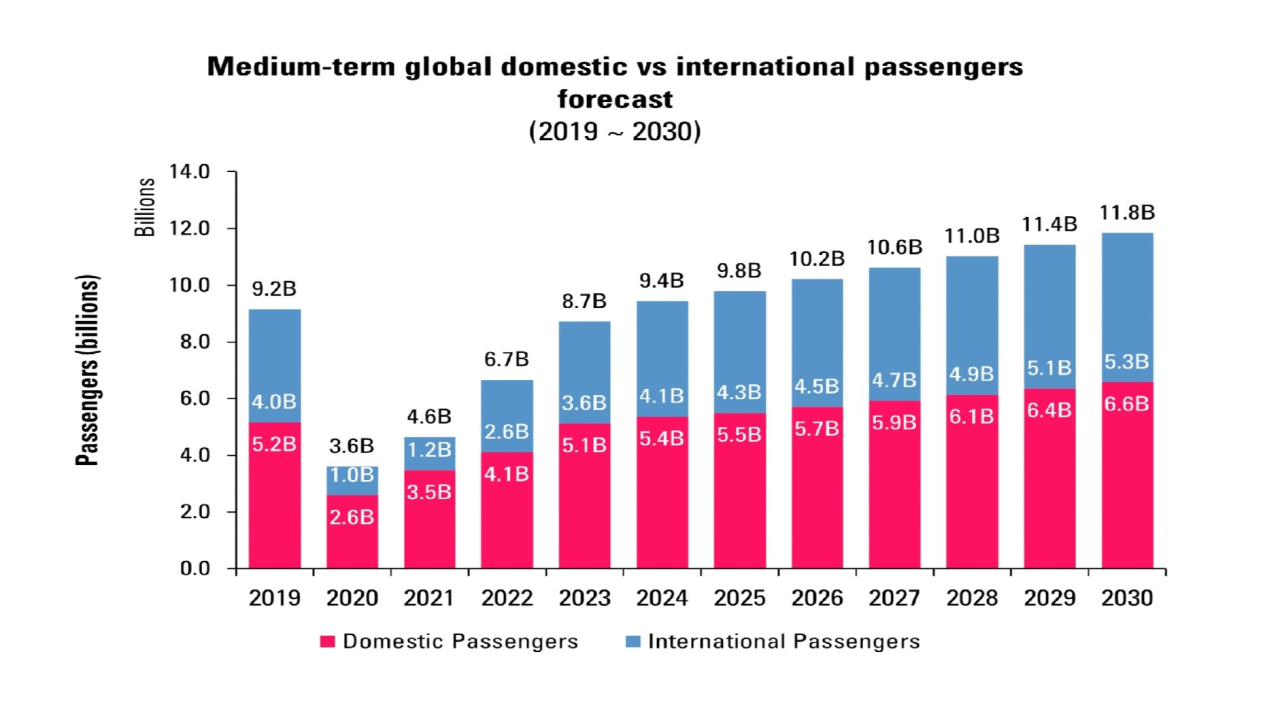
This year, global air travel is projected to come very close to a historic milestone of 10 billion passengers. According to a forecast from Airports Council International World (ACI World), 2025 should hit 9.8 billion, growing by 3.7% year-over-year (YoY). And 10.2 billion flyers are set to take off and land in 2026.
The data have been released in ACI’s latest World Airport Traffic Report (WATR), which draws on information from over 2,800 airports across 185+ countries and territories. As the most extensive overview of the global airport industry and aviation markets, the 2025 report includes up-to-date data for the operating year 2024 and the first half of 2025.
As for the forecast for this year, ACI World Director General Justin Erbacci said: “Air travel is on track to reach 9.8 billion passengers, underscoring aviation’s role as a driver of global mobility and economic growth. International travel remains the main engine of growth, but regional variations reflect a mix of structural strengths, policy challenges, and evolving travel patterns.”
Regional Patterns are Uneven
In terms of regional growth engines out to 2030, Western markets—specifically Europe and North America—are going to lose out to the developing markets of Africa, the Middle East, Latin America/Caribbean, and Asia-Pacific. The latter four will all grow at above-average rates until 2030, supported by rising demand and a growing presence of low-cost carriers. Meanwhile, Europe and North America fall below the average (see chart below).

© ACI World
This year, international traffic growth of 5.3% will be more than double the 2.4% for domestic traffic. Until mid-2025, domestic traffic had fared even more poorly: down by 0.7% YoY, while international traffic jumped by 4.9%.
However, it is in the regions where top-line differences are already diverging when it comes to growth. Africa is forecast to reach 273 million passengers in 2025, up 9.4%, and the Middle East should hit 466 million passengers, up 5.9%.
Africa’s strong growth will be led by Northern Africa and boosted by tourism and rising middle-class demand, while the Middle East’s rise will be underpinned by investment and tourism, “though risks from geopolitical instability remain,” said ACI World.
In Asia-Pacific, 3.6 billion passengers will travel in 2025, up 5.6% YoY, driven by demand in Southern and Southeast Asia, while East Asia’s outlook remains cautious. Latin America/Caribbean is forecast to reach 789 million passengers in 2025, up 4.1%, supported by leisure demand and low-cost carrier expansion in several markets, such as the Dominican Republic.
In contrast, Europe’s growth will only be 3.6%, transporting 2.5 billion passengers in 2025, while North America is set to reach 2.1 billion passengers in 2025, having seen the U.S. domestic market contract by 2% in H1 2025 while international traffic rose 1.0%.
Lack of Clarity
But the outlook remains uncertain there, shaped by visa rules, travel restrictions, and trade policies. ACI World said: “Leading indicators suggest a weaker second half, though it is unclear whether this is temporary or part of a longer-term shift.”
There are also other key factors at play in developed markets, including geopolitical tensions, demographic shifts such as aging, and changes in traveler behavior due to uncertainty and visa policies.
Though global traffic is moving in the right direction in the medium term, ACI World is keen to see those trends boosted through better decision-making. Erbacci said: “To sustain air travel demand globally, regulators must foster policies and frameworks that enable improved connectivity, long-term resilience, and sustainable growth.”