
Login/Register
How Latin American Airports Are Redefining Commercial Value
Rodolfo Echeverria
August 19, 2026

The ACI LAC Commercial Forum took place in Mexico City at the end of July.
© Bhargava Marripati / Unsplash
The atmosphere at the recent Latin America and Caribbean (ACI LAC) Commercial Forum in Mexico City was practical rather than celebratory. The event brought together a cross-section of airport executives, concession managers, advisers and commercial partners, but while passenger traffic may be growing, a central question remained: how can airports convert those volumes into commercial and financial value?
That question also framed the contribution from Modalis Infrastructure Partners, delivered by me. Commercial revenue is often discussed as an operating line, but within an airport concession it can influence cash generation, debt capacity, resilience and ultimately valuation.
Stable and collectible commercial income can strengthen cash flow available for debt service (CFADS) and the debt service coverage ratio (DSCR), depending on how much value the concessionaire is permitted to retain. The objective is not simply to sell more but to design strategies, contracts, and incentives that allow commercial value creation to reach the project’s cash flow.
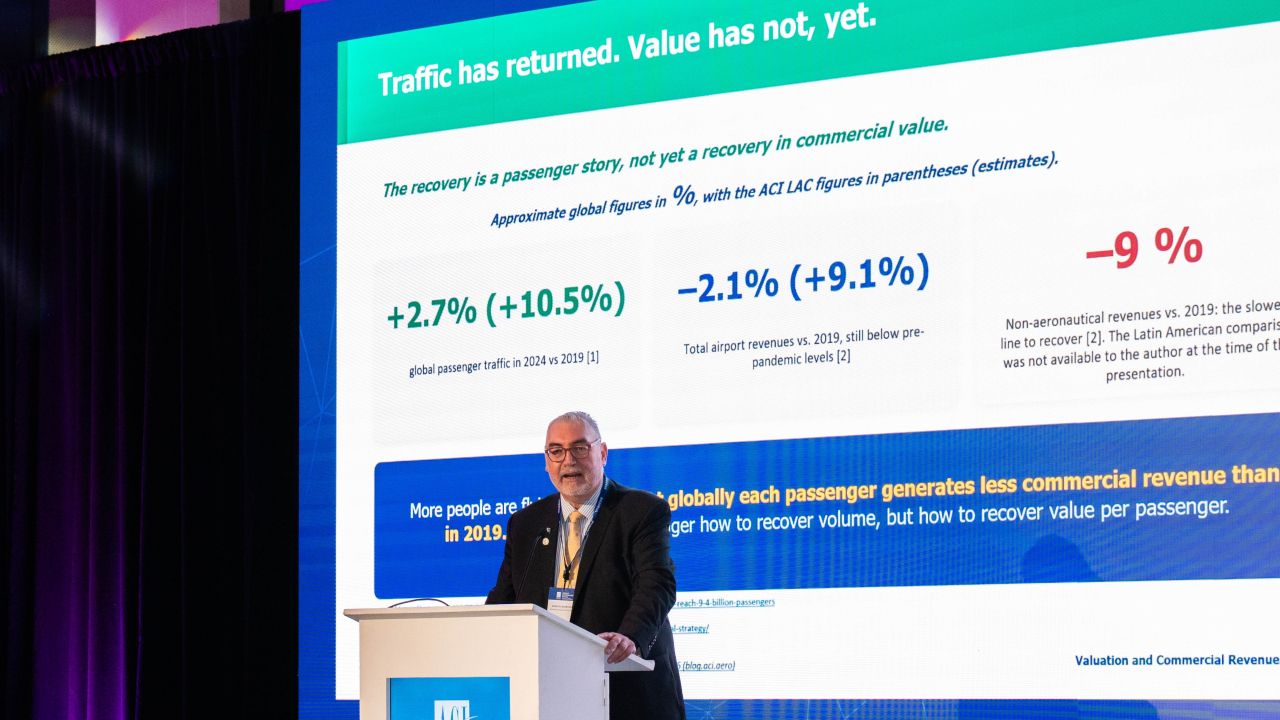
Rodolfo E. Echeverría addresses the audience at the ACI LAC Commercial Forum.
© Rodolfo E. Echeverría
Commercial Planning Sits Across Many Functions
Paula Santos of KILSA Group brought the discussion from finance into execution. Her presentation distinguished passenger growth from commercial growth. More passengers, or more terminal space, do not automatically produce a stronger business.
A credible commercial masterplan begins with passenger behavior, airport positioning, and an understanding of the environment the airport intends to create. It then translates those choices into a mix of concepts, zoning, brands, digital touchpoints and flexibility.
The airport commercial leaders’ panel reinforced the idea. Commercial planning now sits at the intersection of operations, passenger expectations, concession structures, and managing partners across different markets. The commercial function extends beyond leasing space and negotiating concession agreements. It increasingly requires coordination across finance, operations, customer experience, infrastructure, and technology.
That theme continued through the passenger insight sessions. Anna Degli Esposti of m1nd-set showed that value remains important, but experience is increasingly decisive in converting interest into spend. Airports cannot rely only on price, duty-free visibility, or familiar international brands. They must understand why passengers enter a store, why they hesitate, and what gives them a reason to purchase.
Rafael Diaz and Valentino Piatek of Aeropuertos Argentina presented personalization as an operational discipline rather than a marketing slogan. For AA, the passenger journey framework connects research, passenger profiles, airport typologies, digital platforms, and decision-making. A key idea was to standardize without making every airport identical; applying common methods while preserving the differences that make each gateway and destination commercially meaningful.
That balance appeared in presentations by Sharon Hislop-Holt of Sangster International Airport (MBJ) and Javier García Bejos of Aeropuertos Mexicanos. In Montego Bay, commercial identity is unmistakably Jamaican. Architecture, hospitality, technology, and commercial opportunities form one passenger journey, creating a sense of place rather than a neutral terminal with shops. Aeropuertos Mexicanos addressed the same challenge through airport transformation, linking service standards, infrastructure, and commercial strategy.
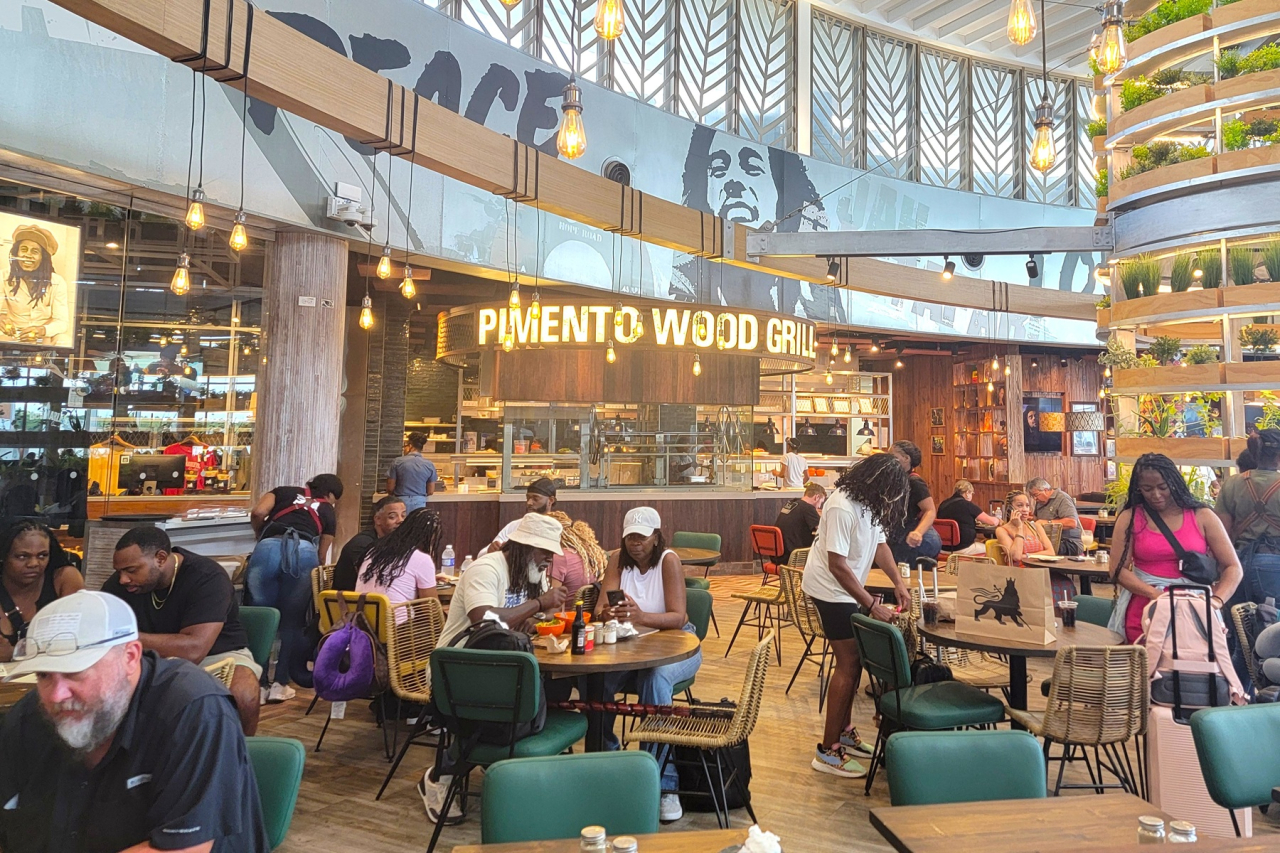
Sangster International Airport in Montego Bay, Jamaica has a distinct sense of place.
© Curtis Grad /
Lounges Become More Strategic
The afternoon widened the commercial lens. Lounges were considered not only as premium amenities, but as strategic revenue platforms. Food and beverage (F&B) was discussed as a vehicle for local identity rather than another concession category. The community engagement session, presented by Cassie Schoutens and Adriana Echandi, carried a related message: local trust, pride, and destination relevance can strengthen partnerships and support commercial growth.
Digital technology and artificial intelligence (AI) added another dimension. Sarah Martinache of Expedia Group explored how travel intent begins before the passenger reaches the terminal, while Santiago Andrade of Corporación Quiport examined AI as a source of airport revenue. The most significant idea was not the technology itself, but the widening of the airport’s commercial horizon. The customer journey begins during inspiration and planning, continues through the airport and may extend beyond departure.
Bruno Guella’s presentation on Latin America Cargo City (LACC) in Montevideo, followed by the airport city panel, completed the perspective. The airport was no longer merely a terminal or aviation business. It is a platform connecting infrastructure, regulation, logistics, land, services, and regional development. LACC described a shift from moving cargo to orchestrating logistics value, while the airport city discussion positioned airports as regional economic anchors.
The forum’s most compelling message was the convergence of these conversations. Finance, concessions, passenger experience, retail, technology, community engagement and real estate are no longer separate commercial subjects. They are interconnected parts of the same value system. The airports that advance fastest will be those capable of joining them coherently, while preserving the local identity that gives passengers, partners and communities a reason to engage.