
Login/Register
Spanish Traffic Outperforms, Putting Future Charges in Sharp Focus
Dion Zumbrink
August 12, 2026

Adolfo Suárez Madrid-Barajas Airport is Aena's busiest gateway.
© WikiCommons
Aena has once again revised its passenger traffic expectations upwards. Following first-half results, the Spanish airport operator now expects passenger traffic across its national network to grow by around 3% in 2026, more than double the 1.3% forecast published at the beginning of the year. Spanish gateways handled 156.2 million passengers in the first half, 3.7% more than in 2025.
The revision would take Aena’s airports in Spain from 321.6 million passengers in 2025 to approximately 331 million in 2026, compared with the previous expectation of around 326 million.
This difference is important because Aena is currently preparing for its next regulatory period. The proposed third airport‑charges regulatory cycle DORA III (Documento de Regulación Aeroportuaria III) for 2027–2031 includes almost €10 billion of regulated investment. To fund this, Aena has proposed airport charge increases averaging 3.82% per year. The passenger forecasts are an important input, as higher traffic spreads the regulated cost base and investment requirements across more passengers, which would lower the tariffs.
The CNMC (Spain’s competition regulator) has already challenged Aena's assumptions. While the airport operator forecasts 346.7 million passengers in 2031, the regulator considers 366.7 million more realistic and recommends annual tariff reductions of 0.59% rather than increases. With the 2026 starting point now moving higher again, the question becomes increasingly important: will the current growth trend continue over the next five years?
International Markets Drive Growth
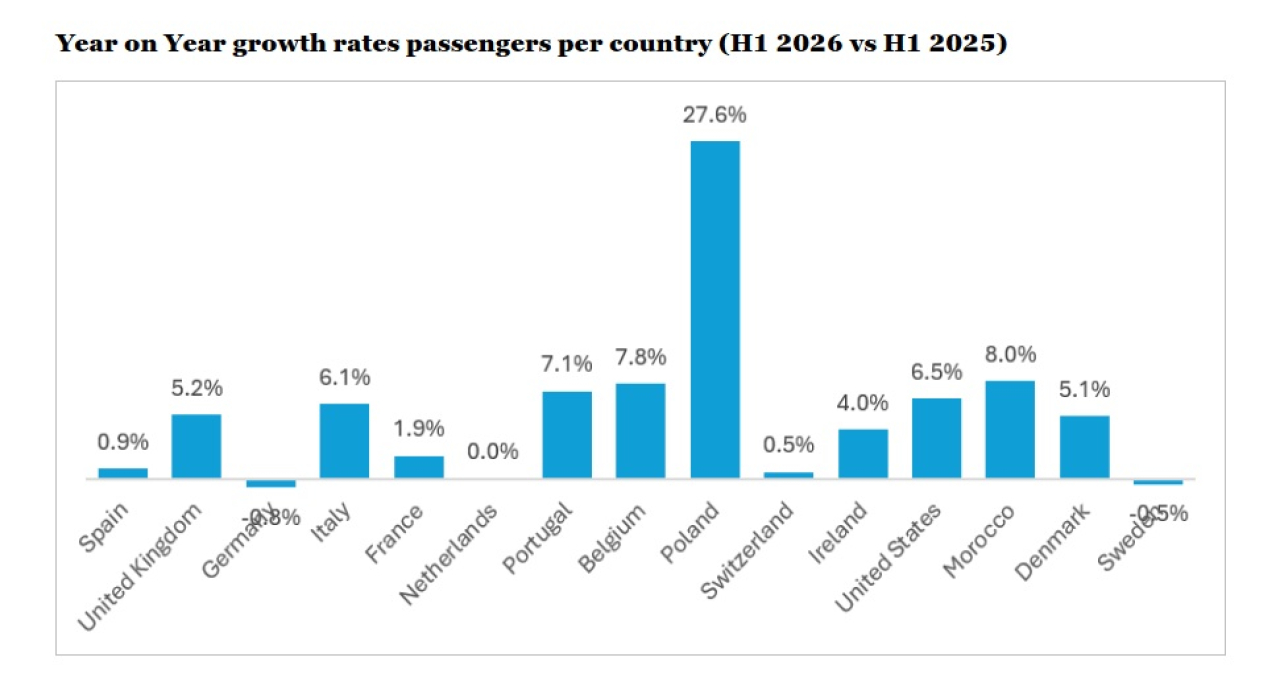
Tourism remains the most obvious underlying driver. Spain received 36.8 million international tourists in the first five months of 2026, 5.0% more than the previous year. In May alone, arrivals increased by 9.5%, while arrivals by air grew by 7.2%. However, passenger growth by market shows that the growth is more nuanced than a general tourism boom (see below).
© Dion Zumbrink
Domestic traffic increased by only 0.9%, meaning most growth is international. The United Kingdom, Spain's largest foreign market, grew another 5.2%. Italy increased by 6.1%, Portugal and Belgium by more than 7%, the U.S. by 6.5%, and Morocco by 8.0%. The standout is Poland, where passenger traffic increased by almost 28%. By contrast, Germany declined slightly.
Spain's growth is therefore becoming more geographically diversified. Traditional northern European markets remain important, but incremental demand is increasingly coming from southern and eastern Europe and North America.
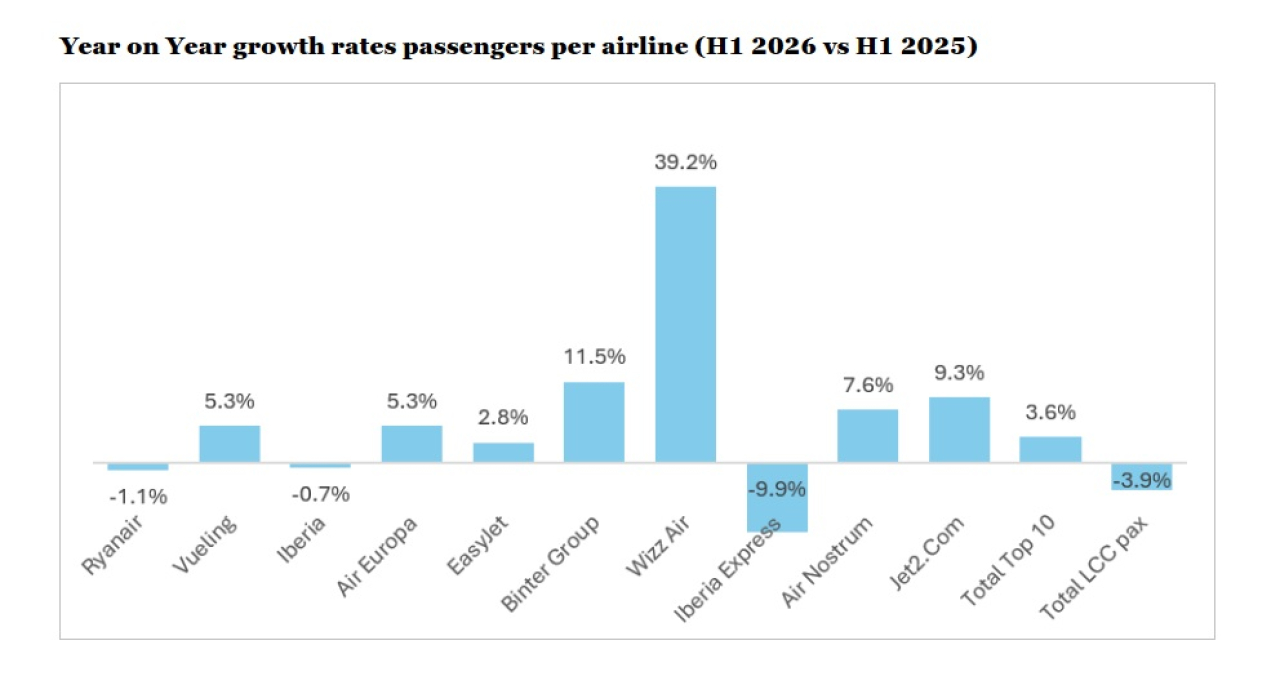
Importantly, Ryanair is not driving Aena's current growth. While still the largest airline in Aena’s network, the low-cost carrier’s passenger volume declined 1.1%, with Iberia down 0.7% and Iberia Express down almost 10%.
Instead, growth is spread across Vueling and Air Europa (+5.3% each), Binter (+11.5%), Jet2 (+9.3%) and particularly Wizz Air (+39%). Wizz Air’s expansion corresponds with the exceptional growth from Poland and other Central and Eastern European markets, while Jet2 continues to benefit from strong UK leisure demand (see chart below).
© Dion Zumbrink
The reported decline in total LCC passengers indicates that the current growth is not driven by LCC-led expansion. There is significant redistribution between airlines and markets within the overall increase.
There are also specific 2026 effects. Aena has highlighted the Middle East conflict, which has diverted some leisure demand towards Spain as travellers seek alternative destinations. This effect may disappear, but there is a stronger underlying base: record tourism demand, expanding international source markets, and increasingly diversified airline capacity.
How Much Might Growth Slow by 2031?
Some moderation is to be expected. Capacity constraints at major airports, a more mature tourism market, and the eventual normalization of temporary geopolitical situations should slow growth relative to recent levels.
If traffic reaches around 331 million passengers in 2026, Aena's 346.7 million forecast for 2031 would require growth of only around 0.9% per year over the following five years. The CNMC’s 366.7 million forecast would correspond to approximately 2.1% annual growth.
This means that the Spanish aviation market does not need to maintain today's growth rates for Aena’s long-term forecast to prove conservative. Higher traffic makes investment in additional airport capacity more urgent, while simultaneously allowing those investments to be funded across a larger passenger base, lowering air fares and potentially stimulating traffic further.
The debate around Aena’s latest forecast revision therefore goes far beyond whether Spain handles five million more passengers this year. The more important question is whether DORA III is being built for a traffic outlook that is already outdated.