
Login/Register
Cancún’s Traffic Decline: More Than a Tulum Effect
Dion Zumbrink
July 15, 2026

Aerial view of Cancun's beachfront hotels and clear waters.
© Zachary DeBottis / Pexels
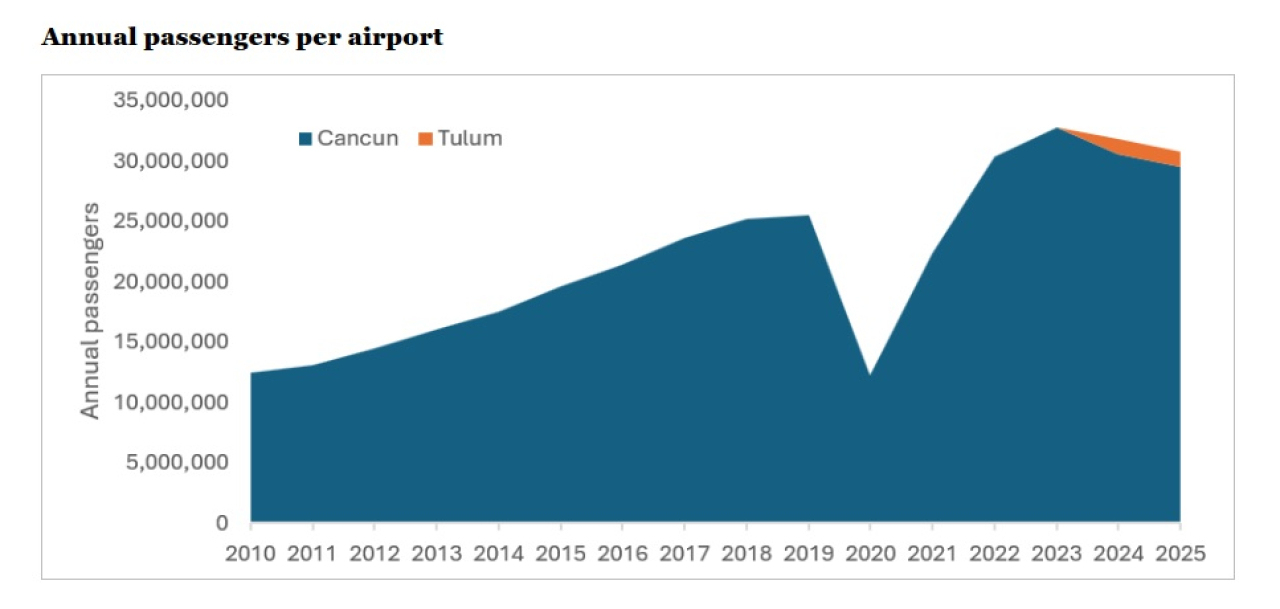
When Tulum International Airport (TQO) opened in December 2023, it became a second gateway to the Riviera Maya and coincided, almost exactly, with a reversal in Cancún’s long-running traffic growth. After reaching a record 32.8 million passengers in 2023, Cancún Airport (CUN) fell to approximately 29.5 million in 2025.
The timing begs the question: is Cancún simply losing passengers to Tulum, or is the wider Riviera Maya air travel market weakening?
The latest traffic data increasingly points towards the second explanation. TQO has redistributed some traffic within the region, but its growth has not been large enough to explain Cancún's decline. Moreover, Tulum itself has experienced a sharp correction following its initial launch.
© Dion Zumbrink
Tulum Passenger Development
TQO handled around 1.2 million passengers in 2024, its first full year of operation, and closed 2025 at a broadly similar level. The rapid initial ramp-up remained well below the airport's design capacity of 5.5 million passengers.
The flat annual figure hides a strong decline within the year. Monthly traffic reached approximately 144,000 passengers in March before falling to 120,000 in April, 93,000 in July and 84,000 in August, a reduction of more than 40% from the March peak. This is larger than normal seasonality would explain.
The main factor was airline behaviour. TQO launched with an ambitious international schedule, and airlines reduced this when off-peak load factors underperformed. During 2025, flights were lost: Delta cut Detroit and Minneapolis and kept only Atlanta, United suspended Los Angeles, Chicago O'Hare and Newark, Copa dropped Panama City, Avianca withdrew Bogotá, Air Canada cut Ottawa and Quebec, and Discover (Lufthansa) withdrew Frankfurt, moving it to Cancún.
Cancún Passenger Development
CUN lost around 2.2 million passengers between 2023 and 2024, while TQO handled approximately 1.2 million passengers in 2024. Even assuming that a large proportion of Tulum's passengers would otherwise have used Cancún, the scale of Tulum's traffic is insufficient to explain the full Cancún decline.
The decrease continued in 2025. CUN lost approximately another one million passengers, while TQO remained broadly flat. Its opening, therefore, does not appear to be the primary explanation for Cancún's sustained contraction.
National Context Shows the Decline is Selective
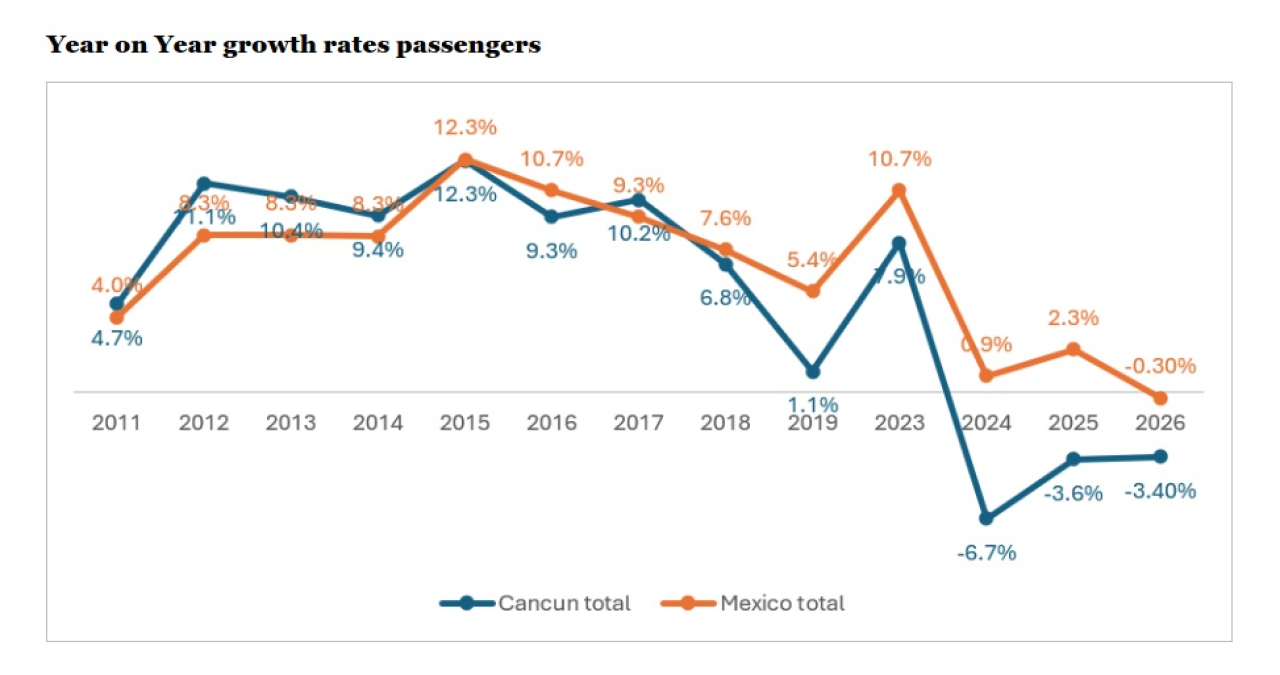
Cancún traffic fell by 6.7% in 2024, while total Mexican airport traffic still increased by around 0.9%. In 2025, CUN declined by a further 3.6%, while Mexican airport traffic grew by approximately 2.3%. The divergence has continued into 2026. Cancún handled 12.7 million passengers between January and May, down 3.4% year-on-year, whereas total Mexican airport traffic was broadly stable at -0.3%.
© Dion Zumbrink
CUN has consistently underperformed the Mexican market since 2024, pointing to factors specific to Cancún and the Riviera Maya. The area is particularly dependent on international leisure traffic, and the U.S. is its most important source market.
The latest statistics show that in the first five months of 2026, scheduled passenger traffic between Mexico and the United States declined by 5.8%. Other Mexican tourist destinations with a strong U.S. tourist base have also shown declines in 2026.
As overall U.S. outbound international travel has remained resilient, the weakness may not be caused by Americans travelling less internationally, but rather by Mexico capturing a smaller share. Several factors may be contributing. The exceptional growth of CUN during 2021–2023 was partly attributable to Mexico’s rapid reopening and strong positioning in the post-pandemic travel recovery.
As competing destinations fully reopened, US travellers again had a broader choice of international destinations. At the same time, record sargassum levels in 2026, which cover beaches in algae and a Level 2 travel advisory on Quintana Roo, could further impact tourism demand. For Cancún, the impact is amplified by its high dependence on leisure demand. Airports with more diversified domestic, business or VFR traffic are less exposed.
Wider Riviera Maya Challenges
Tulum has diverted some traffic from CUN and with TQO itself now seeing airline capacity rationalisation, the evidence points to a broader slowdown in Riviera Maya, particularly in the U.S. leisure market.
Both airports therefore face the same underlying challenge: restoring growth in a Riviera Maya market that is more competitive and less buoyant than during the post-pandemic boom. Diversifying source markets may form part of that response, but the immediate challenge is rebuilding demand in the region's core North American leisure market. Government involvement, supported by marketing, safety improvements, and a solution to the sargassum issue are key to getting the region back on a growth track.