
Login/Register
Middle East/Africa Traffic Down 29% in Q2 as Global Flows Reshape
Kevin Rozario
July 22, 2026
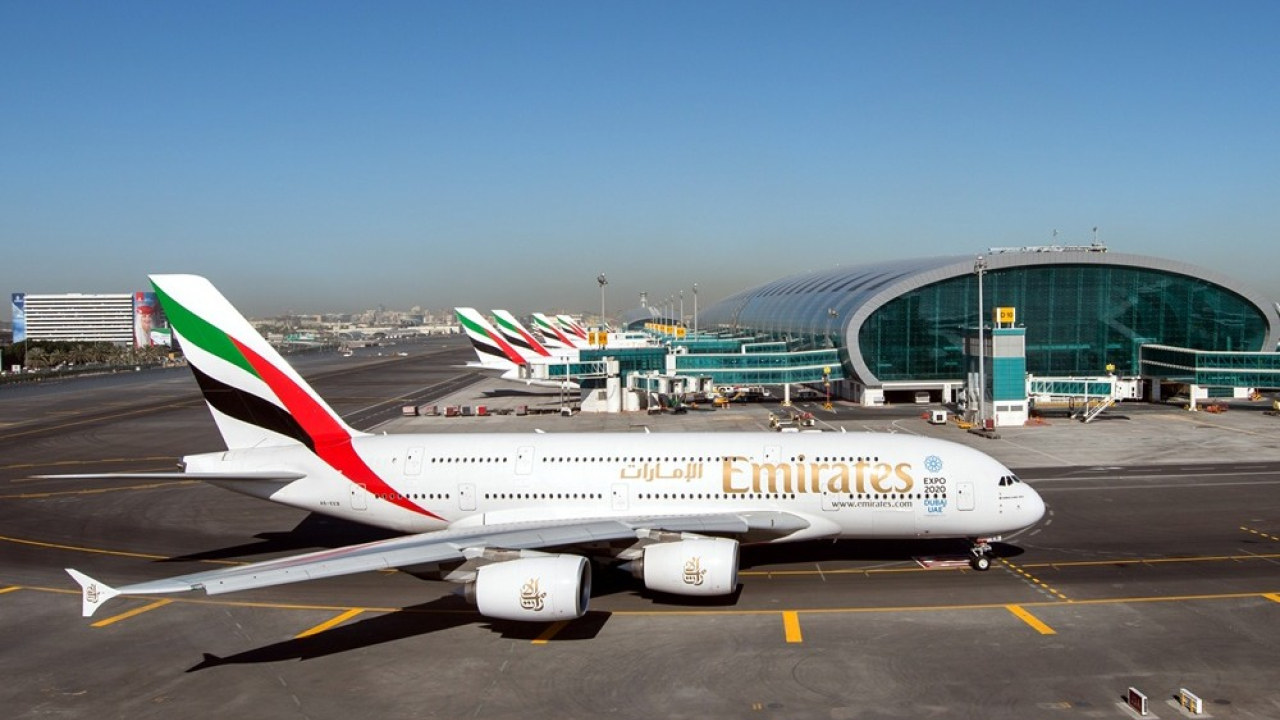
The Middle East is still heavily impacting global traffic growth.
© Emirates
The US-Israel attack on Iran that started on 28 February hit regional air traffic hard in the Middle East in Q2 2026. The Gulf’s leading hub, Dubai International (DXB), was no longer perched atop international airport traffic lists—or even in the lead rankings—and July’s resumption of American bombing means that the region’s traffic woes will be prolonged.
New data from the Q2 KPI Monitor from the Duty Free World Council (DFWC), produced exclusively for it by Swiss research agency m1nd-set, indicate that the Middle East and Africa’s international traffic crashed to just 48 million international departures, a 29% fall year over year, driven by the difficulties faced by Gulf airports, which have a crucial role in the global transfer business.
According to ACI Asia-Pacific & Middle East, the nine top hubs in the region handled about 18% of the 197 million passengers that connected east-west between Asia-Pacific and Europe and the Americas last year. A lot of re-routing has therefore taken place since March.
In Q2, all other regions showed growth (see chart below), with Asia Pacific, North America, and South America all up 5% year-on-year, processing 138 million, 66 million, and 35 million international passengers, respectively. Europe was the straggler at 2% growth, but with the most international departures at 292 million.
Due to the deep impacts of the Middle East crisis, the DFWC data show that growth in other regions could not offset an overall decline in global air traffic. There were 580 million international departures (including both connecting and non-connecting passengers) in Q2, down 1% on the same quarter last year.
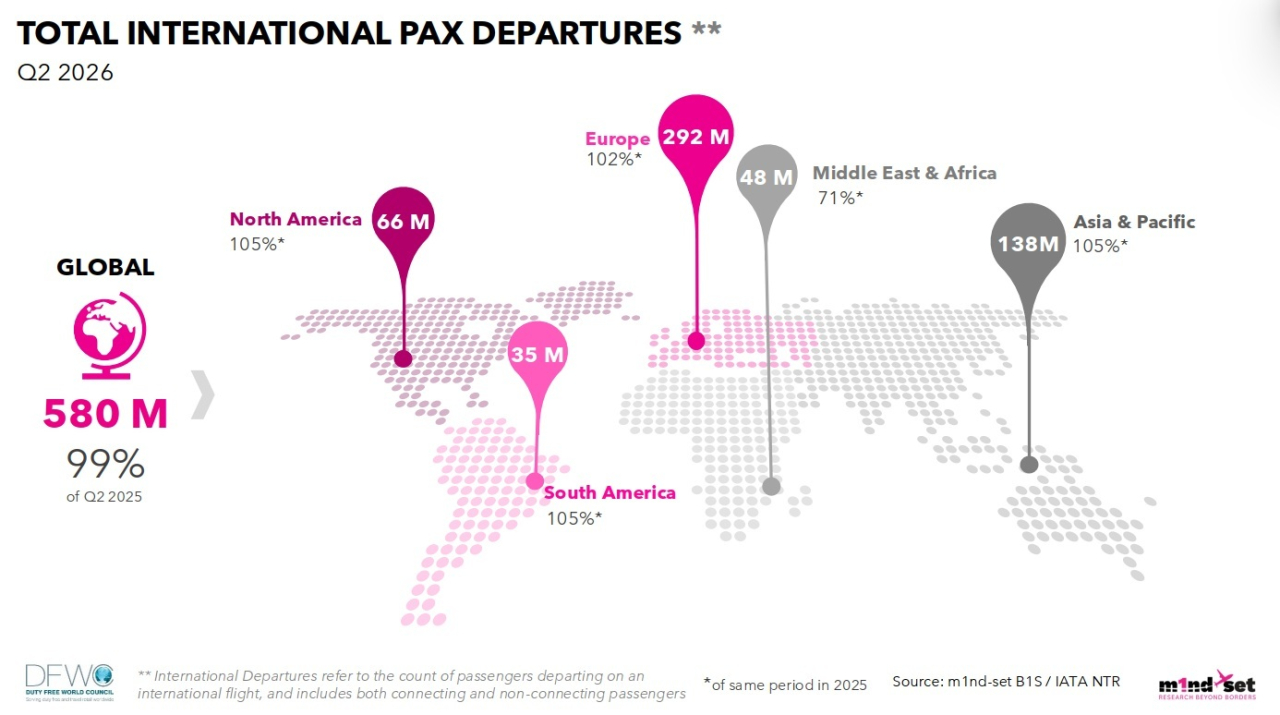
The Middle East pulled down global growth into negative territory.
© DFWC/m1nd-set
DXB Out of the Top 10 International Rankings
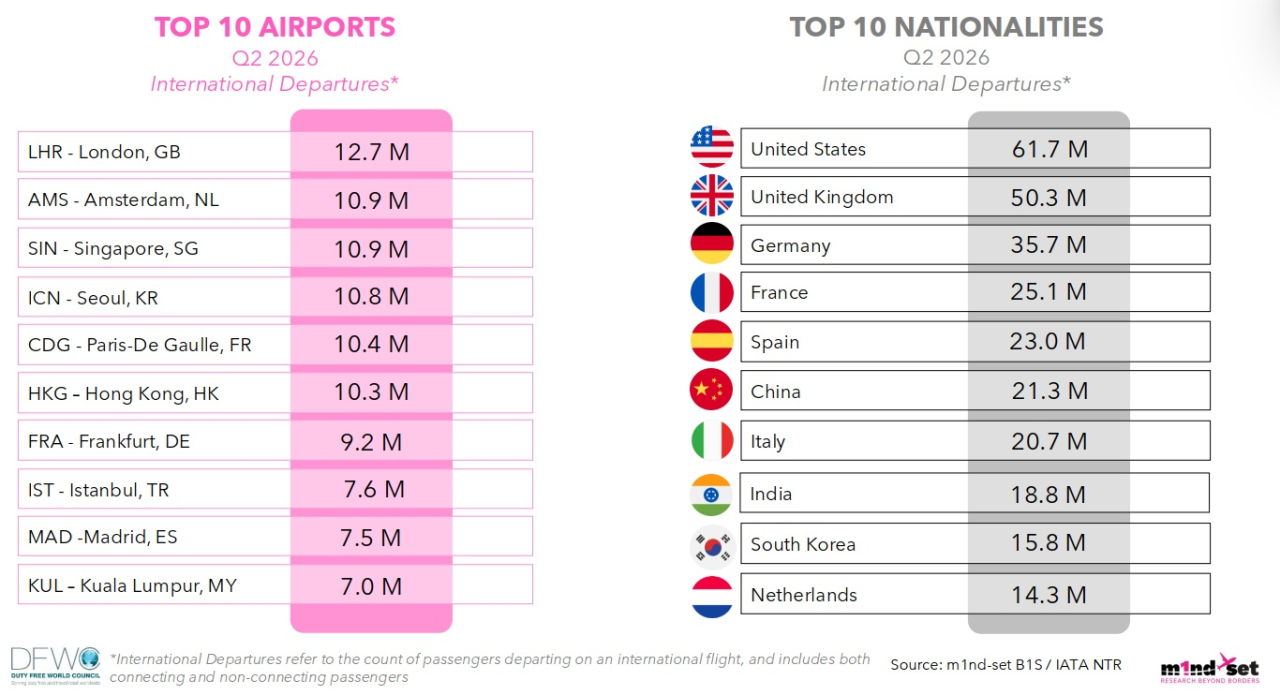
Across the top 10 airports for international departures in Q2, the rankings, for the most part, were unchanged. Crucially, Dubai International (DXB) was conspicuously absent due to the regional conflict, even though Emirates had returned 96% of its global capacity in early May.
London Heathrow (LHR) topped the listing with 12.7 million international departures, followed by Amsterdam Schiphol (AMS) and Singapore Changi (SIN) in joint second with 10.9 million international departures, just nudging ahead of Seoul’s Incheon Airport (ICN) with 10.8 million. Paris Charles de Gaulle (CDG) ranked fifth with 10.4 million international travellers (see chart below).
© DFWC/m1nd-set
In a renewed unstable environment in the Middle East following the restart of hostilities, Sarah Branquinho, DFWC President, commented: “With geopolitical tensions in the Middle East creating an increasingly uneven global landscape, the DFWC traffic data clearly illustrates the vulnerability of international travel to external influences and shocks. While the sharp decline in traffic across the Middle East is significant, the resilience shown by Asia Pacific, Europe, and the Americas underlines a fundamentally strong appetite for travel.”
Whether that appetite returns to the Middle East region remains to be seen. At seat analyst OAG, the view—before the latest July bombings began—was that it would not be until September at the earliest when filled seat capacities would return to their previous norms.