
Login/Register
ACI Europe and A4E: Europe’s Entry/Exit System “Not Delivering”
Kevin Rozario
October 18, 2026
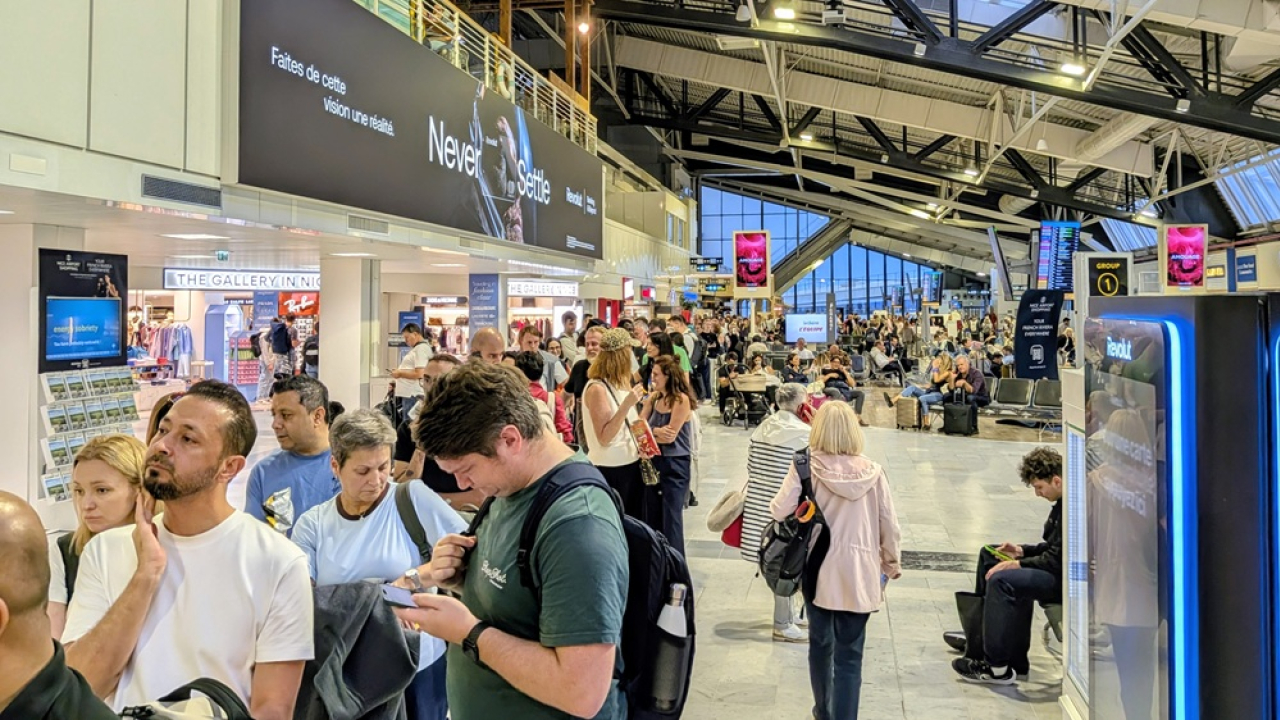
This border-check queue at Nice-Côte d’Azur Airport (NCE) in early October extended across the entire length of the terminal.
© Kevin Rozario /
ACI Europe and Airlines for Europe (A4E) have come together to put forward a six-point plan to address what they see as the poor performance of the Schengen entry/exit system (EES) a year after its first-phase implementation.
The organizations representing Europe’s key airports and airlines say passenger waiting times remain “unacceptably high… hitting up to five hours at peak traffic times” in the worst cases, and routinely exceed two hours. This is causing significant disruption for passengers, airports, and airlines across the Schengen area.
Both want immediate operational and regulatory changes to the EES, although the European Commission has been much more circumspect, minimizing the issues despite mounting evidence. President Ursula von der Leyen said this summer that the system was experiencing “technical problems” but that they were being solved.
ACI Europe and A4E say the long wait times expose passengers to the very real possibility of missing their flights and connections, while creating severe congestion in terminals which impacts commercial operations, and puts exceptional pressure on border-control, airport and airline staff. The trade associations have been warning about the EES issue for months, but it has remained largely unaddressed.
In a joint statement, Olivier Jankovec, ACI Europe’s Director General, and Ourania Georgoutsakou, A4E’s Managing Director, said: “The EES has strengthened the security of Europe’s external borders – that is a clear achievement. But six months into its full rollout, the system is not delivering on the promise of faster, more seamless travel.”
They added: “This is no longer a teething problem, nor can passengers, airports and airlines keep paying the price for avoidable disruption. The time for simply managing the symptoms is over. We need decisive action to fix the structural problems in the EES.”
A Six-point Plan
The associations describe their plans as “concrete proposals” specifically aimed at reducing operational constraints, streamlining biometric and data processes, increasing the use of remote pre-enrolment and automated border control, and providing operational flexibility during periods of sustained congestion. The six points are as follows:
- Eliminate ‘double verification’
- Optimize biometric verification
- Prevent duplicate EES profiles
- Rethink and upgrade the Travel to Europe app and web portal
- Accelerate and harmonize automated border control for third-country nationals
- Restore the possibility to partially suspend the EES during excessive waiting times as a permanent mechanism.
Jankovec and Georgoutsakou said: “Europe needs a border management system that is both secure and operationally effective—not one that achieves one objective at the expense of the other. Our six proposals offer a practical pathway towards that outcome. We urge the European Commission and member states to implement them at the earliest, in full cooperation with the industry.”