
Login/Register
Budget 2026: a Slightly Clearer View of Airport Privatization in Canada
Kevin Rozario
November 24, 2026

Nightime view from Toronto Pearson's ATC over the airfield.
© GTAA
When Canadian Prime Minister Mark Carney unveiled plans to open the country's largest gateways to private investment in September, the announcement reverberated across the aviation sector. Since then, some initial details have emerged in the government’s Budget 2026, released in early November.
The decision to admit private entities will initially affect the country’s four busiest airports: Toronto Pearson (YYZ), Montréal–Trudeau (YUL), Vancouver (YVR), and Calgary (YYC). It had been expected in the wake of a policy statement on airport investment issued by Transport Canada in March 2025 (covered by airportIR in detail here).
The airports are fairly well spread across Canada’s four largest provinces by population: Ontario, Quebec, British Columbia, and Alberta. They are home to about 86% of the country’s 41.8 million population, so any public-private partnership (PPP) process at these gateways will affect the vast majority of air travelers in Canada.
It was significant that Carney put airport privatization in play at September’s inaugural ‘Canada Investment Summit’ because it was co-hosted by the Canada Pension Plan Investment Board (CPP Investments) and the Public Sector Pension Investment Board (PSP Investments), two of the country’s largest institutional investors.
Canada’s pension funds are major investors in overseas airports so, for some observers, it was simply a question of time before they would make a move on home turf, with the right framework in place. Carney said as much at the summit: “Canadian pension funds already invest successfully in, and manage, airports around the world. It’s time to bring that same expertise back home to more directly benefit all Canadians.”
The fine details of any airport PPP processes are still being shaped and will be part of a much wider multi-industry plan. The rationale is for a broader push to reduce Canada’s economic dependence on the US under the Trump administration by building a more resilient economy. Carney’s ambition is to catalyze CAD1 trillion in total investment in Canada over the next five years.
Below, airportIR examines the potential airport privatization structure and models that might be considered based on expert views and what is known so far about the government’s thinking.
Investor Insights
At the Canada Investment Summit, only the basic elements of an airport privatization plan were put on the table. They included the following:
- Private operators would run the airports under long-term concessions, not own them outright
- The government will retain ownership of the underlying assets and continue regulatory and safety oversight via Transport Canada
- Proceeds from leases—expected to reach “tens of billions of dollars” — will be reinvested in regional airports, air connectivity, and other infrastructure projects.
Clues to the finer detail came in early November with Canada’s ‘Budget 2026’. The document states that the transition to the new structure is part of a broader plan to build a more affordable, connected, and competitive air sector.
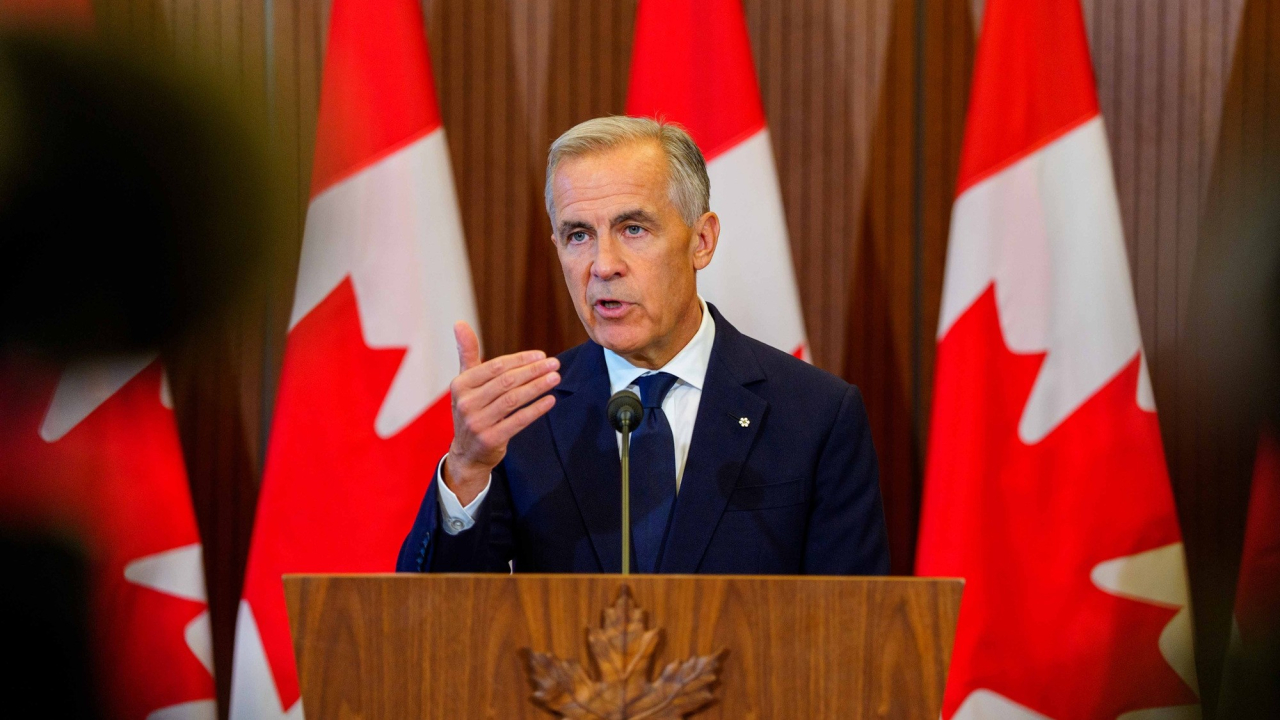
Carney: “Canadian pension funds already invest successfully in, and manage, airports around the world. It’s time to bring that same expertise back home.”
© Lars Hagberg / Prime Minister of Canada's Office
Leases up to 50 Years
The Budget, titled Masters of our Destiny, notes: “To prepare Canada’s air transportation system for the future, we are seeking private investment through long-term operating concessions for our four largest airports. Under this model—used successfully in other countries—experienced investors, like Canada’s pension funds, would operate airports for 40 to 50 years.”
A key change is that long leases for YYZ, YUL, YVR, and YYC will replace the current non-profit airport-authority model as part of the National Airports System (NAS) with for-profit operators, while airport assets stay in public ownership. That is an important distinction as many historic airport privatizations have involved outright asset sales or long-term leases to overseas infrastructure funds. Canada’s model is designed to keep ownership public while channelling pension capital that is heavily invested in airports abroad back into domestic infrastructure.
The document adds that airport fees included in the price of an airline ticket would be subject to “clear rules to protect travelers from unreasonable increases.” The argument for privatization is that it opens the door to new investment and expertise, which in turn will improve airport services and infrastructure, and expand travel and tourism options.
This cascading effect does not always materialize when it comes to travel and tourism, as many other factors are at play. These include airline capacity, route networks, visa policy, exchange rates, as well as geopolitics—illustrated by the travel downturn from Canada to the U.S.

Budget 2026 offers an initial airport privatization timeline.
© Government of Canada
A sweetener from the Budget adds: “Canadians will share directly in the success of concessions through equity stakes for the Canada Strong Fund [the country’s first national sovereign wealth fund launched in April 2026-Ed] and local indigenous communities.”
In terms of reinvestment, the government says that this could include helping to finance a sovereign broadband backbone that connects Canadians from coast to coast, with more direct and secure links to Europe and Asia.
Canadian Airports Council (CAC) wants any monies raised to stay within the airport ecosystem. Monette Pasher, the council’s President, says: “Our made-in-Canada airport model has served the country very well for more than 30 years, providing a stable, sovereign and financially sustainable approach to managing critical national infrastructure. There is a lot of value in the system.”
She notes that small- and medium-sized airports have identified approximately CAD19 billion in infrastructure needs over the coming decade, and CAC has recommended a new federal infrastructure program to support regional airport growth and economic development.
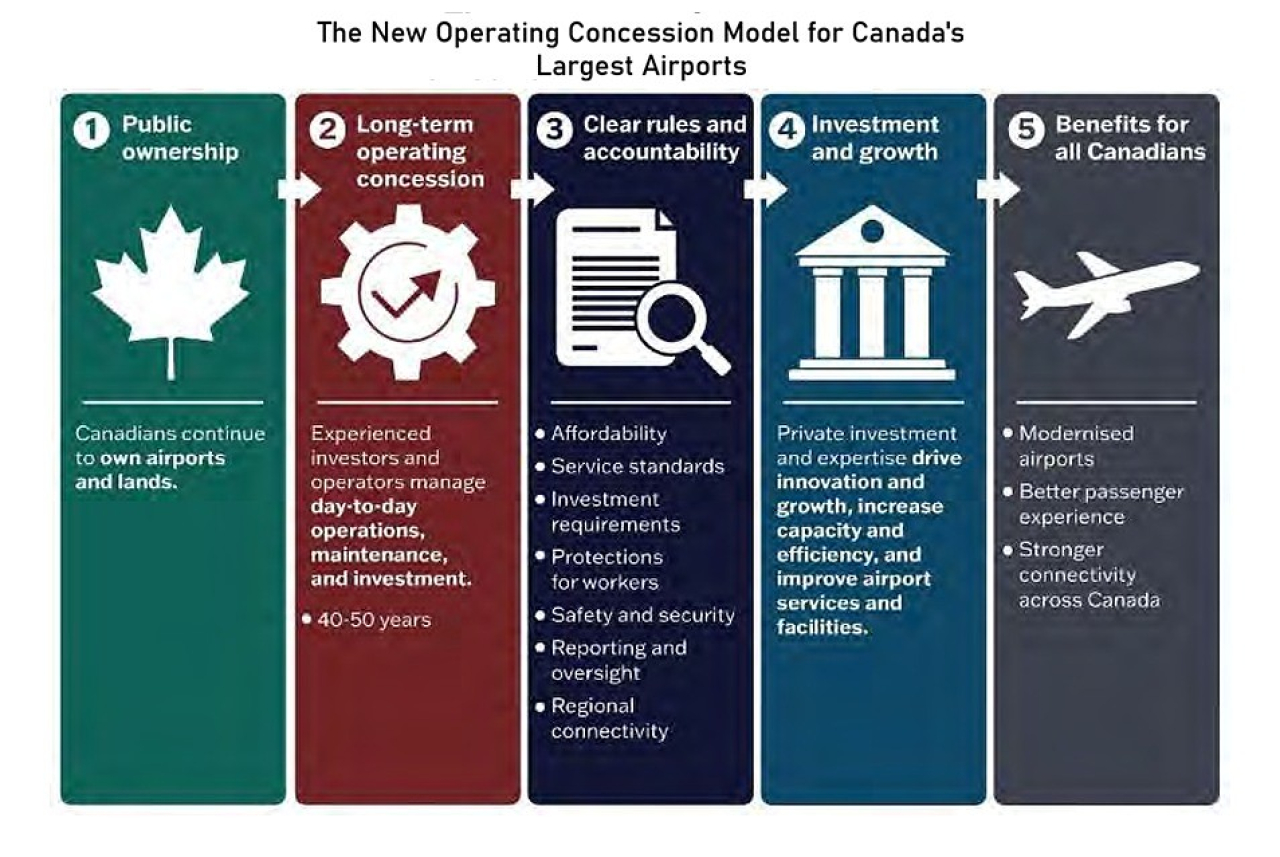
Pillars of the new model.
© Government of Canada
First Operator to be Selected by Early 2029
As part of Canada’s so-called investment supercycle over the five years from 2026/27 to 2030/31, the government plans to spend a total of CAD42 million to mobilize private investment in airports. The peak spending periods, when concession processes go into overdrive, will be 2027/28 when CAD18 million is earmarked, and 2028/29 with another CAD13 million set aside.
The monies will pay for due diligence, developing the concession framework, and obtaining specialized commercial and legal advice. With these elements in place, the government expects “to complete a competitive process to select the first operator by early 2029.”
Once the operator of the first airport is selected, and the model proves successful, the remaining three are likely to follow under a similar framework. It is plausible that a home-grown pension fund, perhaps in a consortium with a mix of Canadian and international companies, will be well placed to secure a role given Carney’s repeated references to the expertise of Canadian pension funds in developing airports overseas.
Further Details Still to Come
While Budget 2026 expressly says that concession proceeds will go towards improving the experience for travelers to prioritize regional connectivity, affordability, and strengthening oversight of Canada’s airports, it has not announced detailed measures.
The government has, however, promised to “adjust the ground rent formula to support growth at airports that will continue to operate under the existing model,” introduce legislation to improve transparency around airport fees, and expand eligibility for the Airports Capital Assistance Program to include smaller airports.
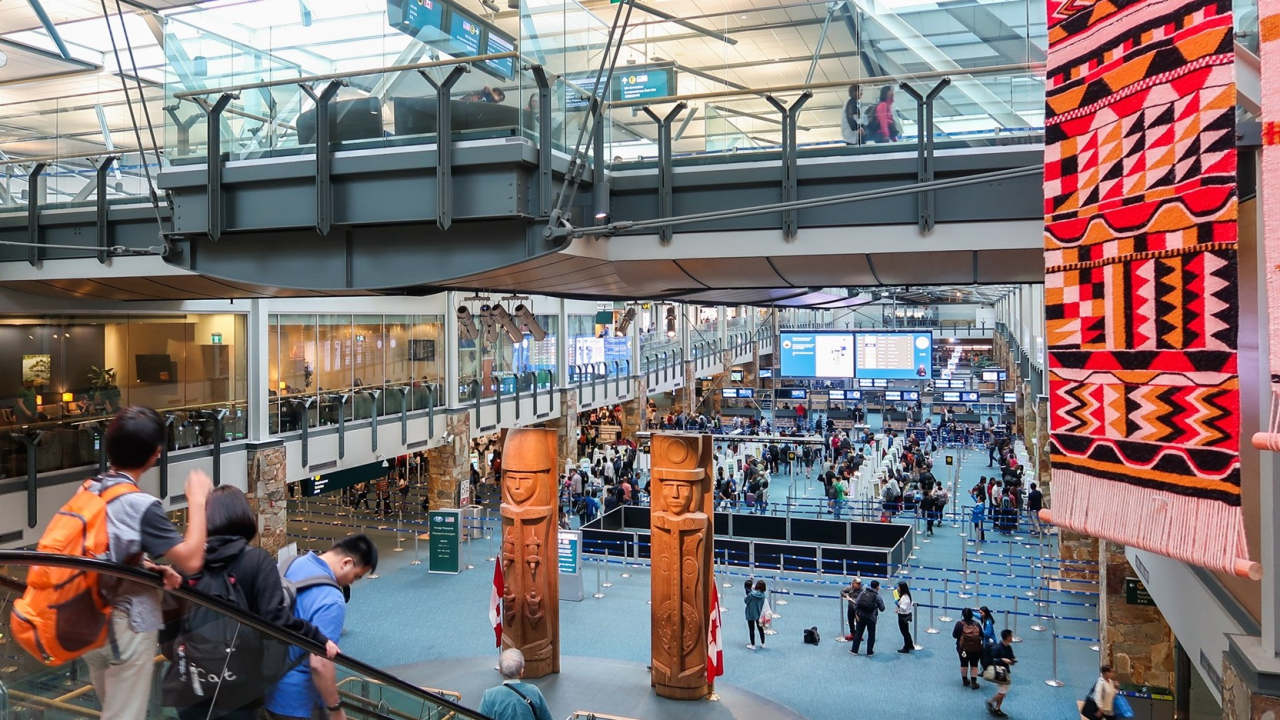
Some observers believe Vancouver International might be the first airport to go under the hammer.
© Wpcpey / Wikipedia
At the time of the summit announcement, Curtis Grad, CEO and Founding Partner of Modalis Infrastructure Partners (the owner of airportIR), told CBC: “It’s early days, but we expect strong interest from the international community. Bringing in the private sector is the next evolution. Realistically, I see the existing airport authorities as being part of the equation. While Canadian gateways are well developed already, they need capitalization, which, with private investment, doesn’t need to come from the taxpayer.”
The need for fresh sources of capital is likely to intensify as passenger demand grows. CAC’s Pasher says: “Canada is entering a period of tremendous growth, and air travel is projected to double in the next decade. Our airports will be essential to moving the people and goods that growth requires. If the government can unlock new value from federal airport assets, a meaningful portion of that should remain within Canada’s airport system to help build the infrastructure and technology Canadians will depend on for decades to come.”

GAD World takes place from 9-10 December in Milan.
Some Vocal Detractors
Not all reactions to airport privatization have been positive. Labor union Unifor—which represents aviation workers among others—has been critical. National President Lana Payne says: “Handing over critical pieces of Canada’s transportation infrastructure to for-profit operators forces travelers and airport workers to fill the pockets of private investors. Public infrastructure must remain in public hands so that all Canadians can benefit.”
Aidan Hollis, Professor of Economics at the University of Calgary, is also cautious about a sell-off. In a recent paper, he says that safeguards need to be in place before any tender process. Among them is the establishment of an independent airport economic regulator at arm’s length from the federal government to assess each airport’s market power. He argues that regulation written into concession contracts and enforced by the seller is a weaker instrument than regulation by statute.
Despite the opposition of unions and concerns from some economists about regulatory safeguards, the direction of travel appears set. The Carney government has moved beyond broad statements of intent and begun allocating funding, designing concession frameworks and preparing legislation.
The real debate is no longer whether private investment will enter Canada’s largest airports, but how it will be structured, regulated and governed. The success or failure of the model is likely to depend less on attracting capital—for which Canada is well supplied through its pension funds—and more on whether policymakers can balance investor returns with affordability, accountability and the long-term interests of passengers and communities.
[For the full timeline of airport privatizations around the globe, take a look at airportIR’s Deal Pipeline. It has the background and the latest updates on all the key airport privatizations currently in progress.]