
Login/Register
Aviation Growth in Brazil Hits New High—What is Driving It?
Dion Zumbrink
November 28, 2026
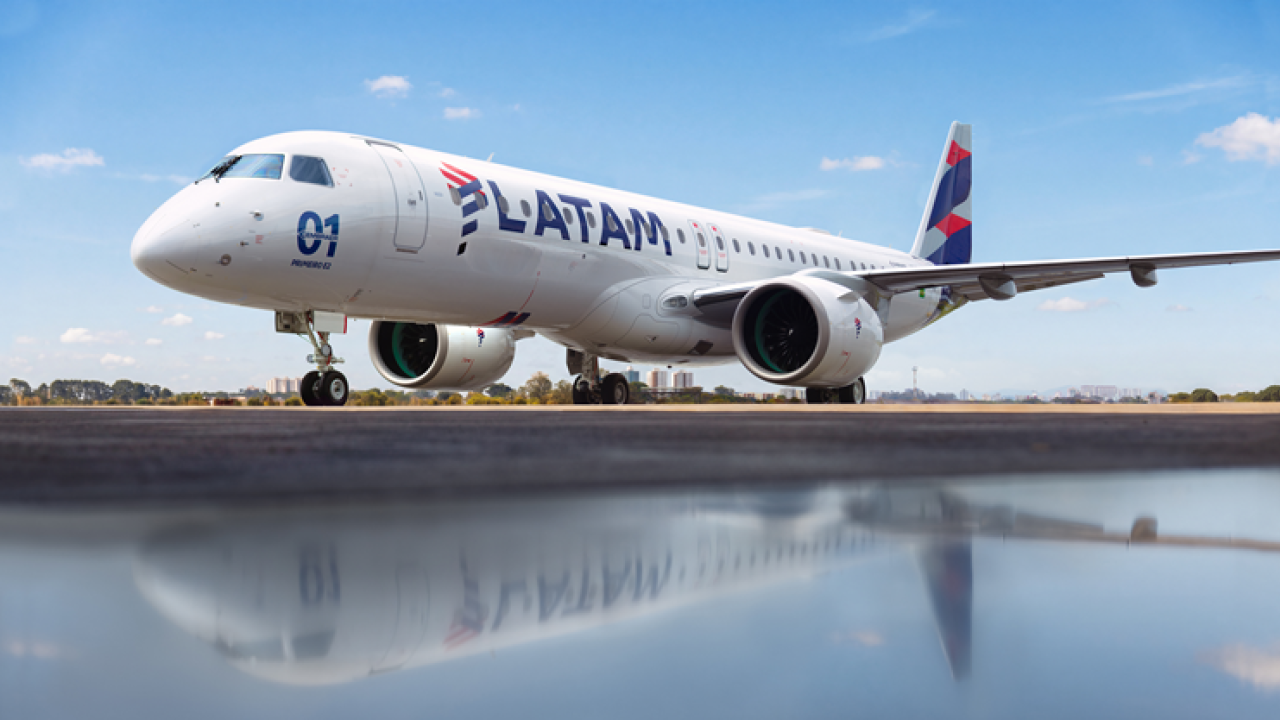
LATAM will take delivery of its first Embraer E195 E2s from next year.
© LATAM
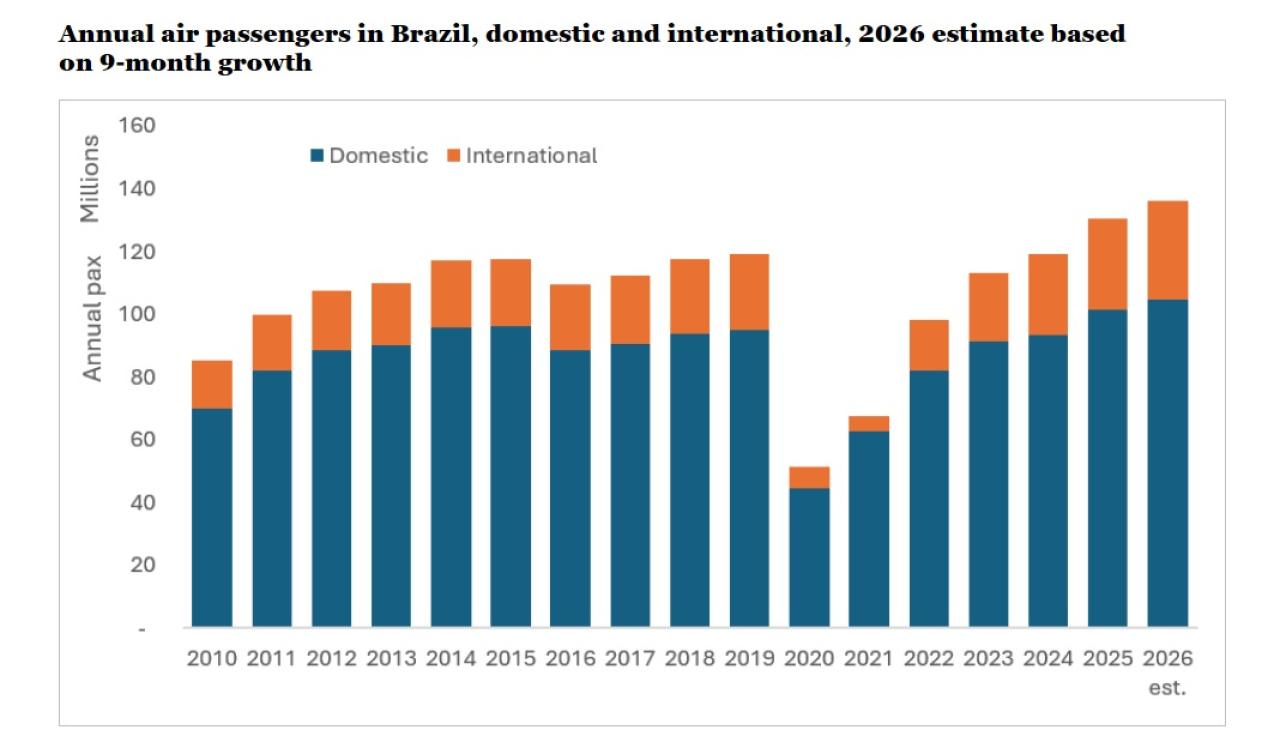
Since a 2014 peak, Brazilian aviation has struggled and passenger volume has remained largely flat. Economic weakness in the mid-2010s, airline restructuring, the collapse of Avianca Brasil, and ultimately the COVID19 pandemic prevented further growth. Even by 2024, passenger volume remained close to the pre-pandemic era.
That changed in 2025. Brazil handled 129.6 million total passengers, 9.4% more than in 2024. The growth continued in 2026, up 4.3% in the first nine months, driven by international traffic, up 7%.
© Dion Zumbrink
Traffic has finally moved substantially beyond its previous ceiling, but this is not simply a pandemic recovery story.
Lower Air Fares and Better Economic Environment
The average real domestic airfare declined by approximately 11% between 2022 and 2025, due to lower fuel prices. In 2025, the fuel price in Brazil was 29% below that of 2022. Simultaneously, economic conditions improved; GDP grew 2.3% in 2025, with GDP per capita up 1.9%, while unemployment fell to 5.6%, the lowest level since 2012. The combination of higher employment, real income growth, and lower airfares has been more supportive of air travel demand than the environment Brazil experienced in the 2015-2019 period.
Airlines are Adding Capacity
The second change is on the supply side. Brazil's airlines are no longer merely rebuilding networks lost during the pandemic. Capacity is moving into new markets. In 2025, total seat supply increased strongly, including a 14.1% increase in international seats, while load factors remained high.
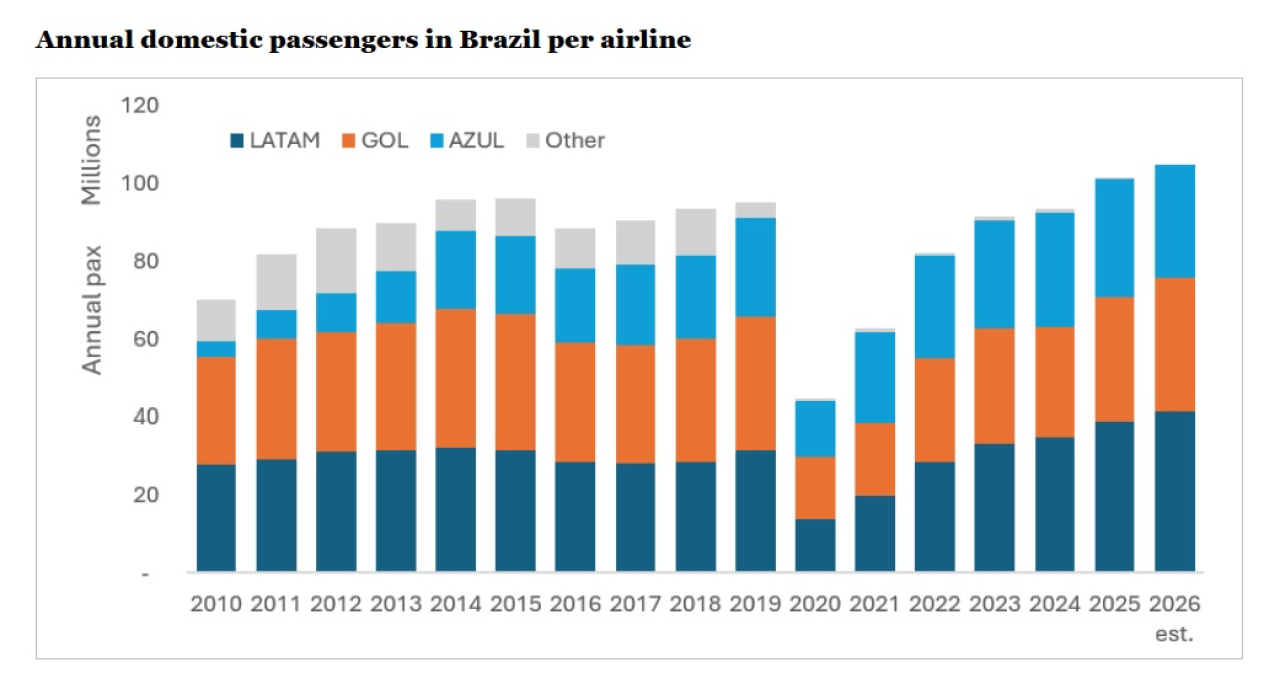
Domestic airline strategies are enabling growth in thinner regional markets. LATAM has expanded from 44 Brazilian airports in 2019 to 63 today, and the carrier expects to reach 67 during the first stage of its Embraer E195-E2 deployment. Up to 14 E195-E2 aircraft are due to enter operation between November 2026 and March 2027.
© Dion Zumbrink
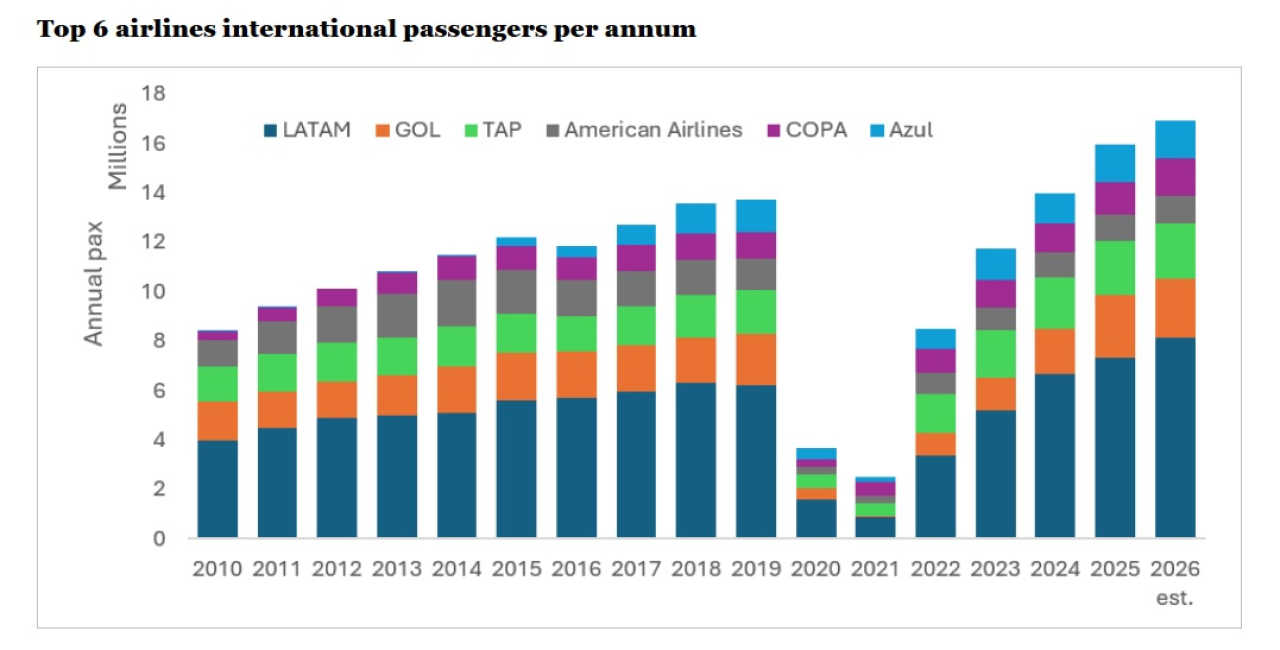
International connectivity has expanded through a combination of Brazilian, European, and Latin American carriers. New services in 2026 included Iberia’s Madrid–Fortaleza route, Copa Airlines between Panama and Salvador, and GOL between Montevideo and Natal, while the Praia–Recife connection was restored.
LATAM is a major driving force in the international market. During 2026, the airline added direct services from São Paulo to Amsterdam, Brussels, Punta Cana, Ushuaia, and Cape Town, while expanding international connectivity outside São Paulo.
GOL’s international strategy is undergoing a significant change. After a slow initial pandemic recovery, international passengers increased by almost 39% in 2024, supported by new markets including Bogotá, Aruba, and Costa Rica. In 2026, the airline introduced widebody aircraft and transformed Rio de Janeiro’s Galeão into the base for its first intercontinental network, with planned services to New York, Lisbon, Paris, and Orlando.
Foreign airlines are expanding as well. Portugal’s TAP has expanded its destinations in Brazil and is expected to carry over 20% more passengers in 2026 than in 2019.
© Dion Zumbrink
International Tourism Spreads Beyond Major Gateways
The largest change since 2025, however, has been international tourism. Brazil received around 9.2 million international visitors in 2025, with more than 6.1 million arriving by air. Air arrivals increased by 33.2% compared to 2024. During the first seven months of 2026, a further 12% year-over-year growth was recorded.
The initial acceleration was strongly supported by neighboring South American markets, particularly Argentina, but demand has broadened across Europe as well. The national geography of that growth is also changing.
Northeast Brazil is the clearest example. International routes increased from 18 in 2023 to 42 in 2026, and available international seats from approximately 605,000 to 1.18 million. New routes include Madrid–Fortaleza, Panama–Salvador and Montevideo–Natal.
São Paulo and Rio de Janeiro remain Brazil's dominant international gateways, but an increasing number of passengers can now reach regional destinations directly.
A Benefit for Coming Airport Transactions
This stronger and increasingly decentralised traffic trend is particularly relevant as Brazil enters another phase of airport transactions.
The latest transactions increasingly incorporate portfolios of regional airports, including the forthcoming Brasília combination together with 10 additional regional terminals. These assets are therefore coming to market at a time when Brazil’s regional airports have a stronger traffic base, broader airline networks, and growing direct international connectivity. These factors potentially strengthen their commercial attractiveness.