
Login/Register
Queen Alia: A Benchmark for PPPs in the Middle East
Rodolfo Echeverria
June 10, 2026

Queen Alia International Airport.
© QAIA
Queen Alia International Airport (AMM), 35km south of Amman, is Jordan’s principal international gateway and one of the Middle East's most studied airport public-private partnerships (PPPs).
Opened in 1983, AMM entered a new phase in 2007 when Airport International Group (AIG) was awarded a 25-year build-operate-transfer (BOT) concession after an international tender supported by the World Bank’s International Finance Corporation. The concession transferred responsibility for financing, rehabilitating, expanding, and operating the airport to AIG.
In 2013, AMM was recognized as one of the top 40 PPP projects in emerging markets, and it has been the subject of numerous studies. Its success was underscored in February 2025, when an official declaration was signed to extend the concession to 2039.
AMM’s transformation was anchored by a terminal designed by Foster + Partners, which opened in 2013 and lifted capacity to 12 million passengers annually. In 2023, traffic hit a record 9.2 million, easing to 8.8 million in 2024, and then rebounding to 9.8 million in 2025, up 11.3%. The swing reflected both AMM’s exposure to regional events and its underlying resilience.
Queen Alia remains publicly owned, while AIG manages operations under the concession. However, the shareholder structure has evolved since the original award, with airport expertise and long-term infrastructure capital becoming important. The current group includes Groupe ADP, Meridiam Eastern Europe Investments, Mena Airport Holding, and Edgo Investment Holdings. The model combines private-sector management, investment discipline, and public ownership, while allowing Jordan to share in the airport's economic upside.
Strategic Positioning & Operational/Financial Performance
AMM’s importance lies in its dual role as Jordan’s dominant origin-and-destination gateway and a hub anchored by Royal Jordanian. The airline mix includes full-service, regional, and low-cost carriers (LCCs) linking Jordan with Europe, the Gulf, North America, Africa, and Asia.
A defining feature of AMM is the gross-revenue sharing mechanism payable to the government. Jordan’s Ministry of Transport and the World Bank Group identify AIG as currently contributing a concession fee of approximately 54.6% of gross revenue.
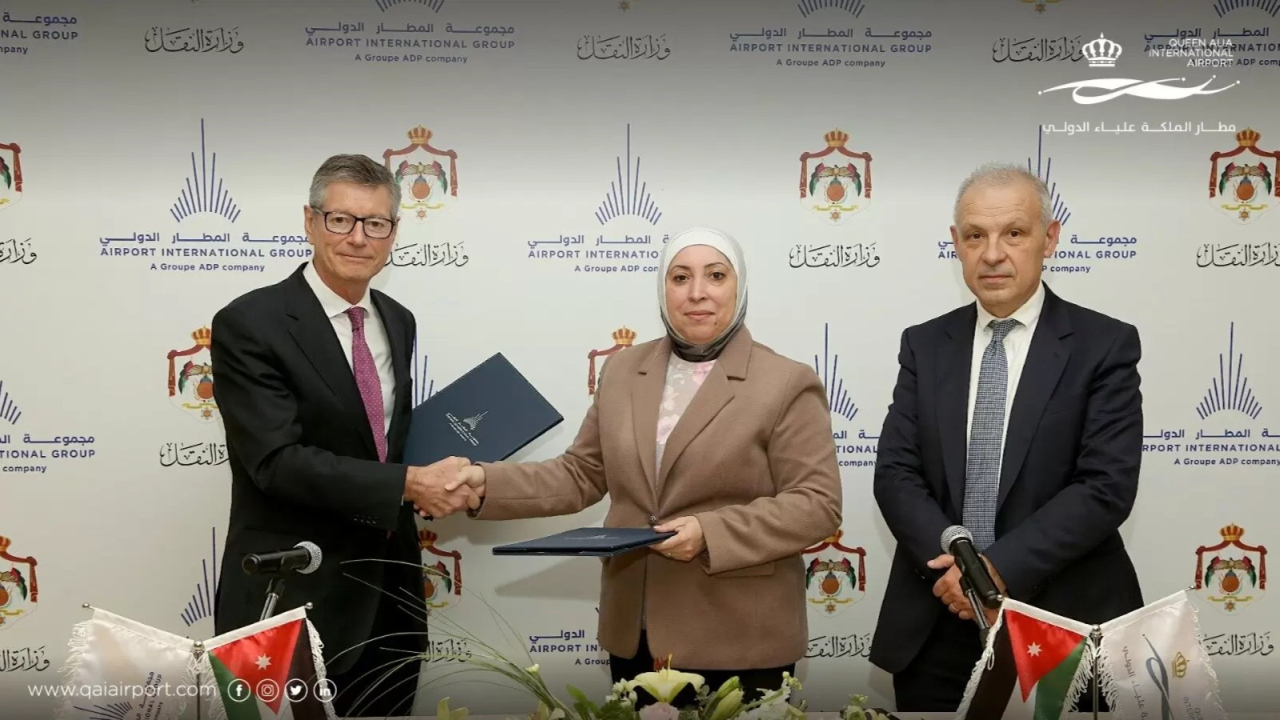
The concession extension declaration was signed by the Minister of Transport, H.E. Eng. Wesam Tahtamouni (center), and the Chairman of Airport International Group, Fernando Echegaray (left), in the presence of the board directors and relevant stakeholders.
© QAIA
Since AIG assumed management of the airport in November 2007, public reporting identified approximately USD1.8 billion in cumulative concession fees paid to the government. In 2024 alone, AIG contributed USD171 million in concession fees, despite regional unrest and lower passenger traffic.
Sustainability & Carbon Accreditation
AMM’s reputation is increasingly linked to sustainability, passenger experience and independent industry recognition. The airport has participated in ACI’s Airport Carbon Accreditation programme since 2012 and renewed its Level 4+ certification in 2025, extending it through May 2028. This has been reinforced by initiatives such as the 2025 inauguration of the Shams al Mattar Lil-Taqa Solar Farm, a 4.8 MW facility expected to generate more than 10.5 GWh of clean electricity annually.
The airport’s service-quality record is also central to the PPP story. AMM received ACI’s best airport by size (5-15 million passengers) in the Middle East in 2024 for the second consecutive year, and eight times in its history. It was also identified as the Most Enjoyable Airport Experience in the Middle East for the second time, based on ACI’s 2024 ASQ survey.
Future Strategic Direction
AMM’s next chapter will be shaped by gateway expansion and reactivation of Amman’s secondary gateway: Amman Civil/Marka Airport (ADJ). It is being promoted as Amman’s city airport, introducing a strategic variable. Marka has resumed commercial operations with a low-cost positioning involving Jazeera Airways and Air Cairo, and aspires to one million passengers in 2026.
For AMM, Marka is both a competitive threat and a system-planning opportunity. If LCCs migrate without coordination, AMM could face pressure on passenger volumes, aeronautical revenue, concession-fee generation, and commercial yield. If managed as a complementary dual-airport strategy, ADJ could absorb short-haul, low-cost, point-to-point, business aviation, and specialized traffic, while AMM concentrates on long-haul connectivity, hub operations, cargo, and premium traffic.
AIG has outlined an enhancement program for Queen Alia from 2026 to 2029 as part of a broader plan that includes 15 terminal and airside projects intended to raise capacity from today’s 12 million passengers to 18 million. The eventual balance across the two gateways will depend on regulation, airline allocation, charges, concession protections, traffic rights, surface access, and Jordan's aviation strategy.