
Login/Register
Patience Pays: San Juan’s Soaring Traffic has Rewarded Investors
Dion Zumbrink
September 17, 2025

During and after the pandemic, San Juan became an accessible option for Americans.
© Nils Huenerfuerst / Unsplash
Puerto Rico’s Luis Muñoz Marín International Airport (SJU) in San Juan has been the only large U.S. airport to successfully transition to private operation under the Federal Airport Authority’s Airport Investment Partnership Program. In 2013, the government of Puerto Rico awarded a 40-year concession to Aerostar Airport Holdings, the joint venture between Mexico’s ASUR and Canada’s PSP Investments.
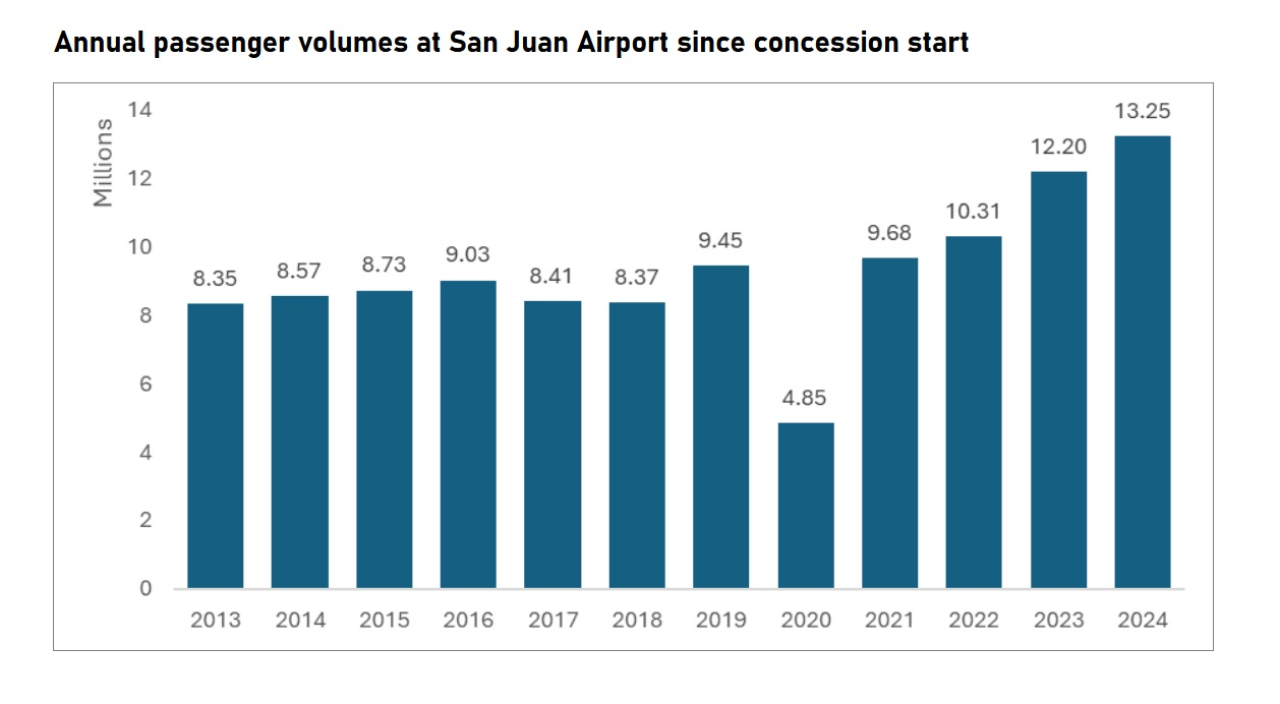
The first years of the concession did not show any significant traffic growth, mainly due to external factors such as an economically difficult period in Puerto Rico, and Hurricane Maria, which left a trail of destruction in 2017. However, remarkably, the COVID pandemic in 2020 seemed to have kicked off a traffic surge; it grew by 40% between 2019 and 2024. This year was also off to a good start, with traffic some 10% higher in the first four months, and Puerto Rico remains among the fastest-growing destinations in the Caribbean.
© Dion Zumbrink
The Flat Years: 2013–2019
The lack of growth in the early concession years (see chart above) was not due to mismanagement or the airport's operational environment, but rather a mix of external events. They included:
- Puerto Rico’s Economy in Prolonged Recession – Fiscal strain and a public debt crisis impacted jobs and disposable incomes. Emigration to the mainland U.S. reduced the size of the local market, weakening demand from visiting friends and relatives (VFR), which, historically, had been a key driver.
- Airline Industry Consolidation – This hit Puerto Rico’s connectivity. American Airlines, once the dominant airline in San Juan, scaled back operations, focusing instead on its mainland hubs. JetBlue partially stepped in but could not fully offset the decline in long-haul and U.S. domestic services lost during this period.
- Hurricane Maria – The 2017 natural disaster devastated Puerto Rico’s infrastructure and added to the challenges above. The storm caused a sharp decline in passenger volumes as tourism collapsed, and recovery efforts took priority.
Turning Point
However by the close of the last decade, SJU had undergone significant modernization under Aerostar’s management. New terminals, enhanced retail offerings, and an improved passenger experience were all put in place, however, traffic development still did not take off. That changed when the pandemic hit.
While the COVID19 crisis, which started in 2020, initially halted global travel, Puerto Rico emerged as a major beneficiary when U.S. travel resumed. As an American territory, the island required no passports, no currency exchange, and no international entry procedures for American visitors. This positioning made it one of the most attractive leisure options for U.S. travelers when restrictions started to ease.
© Dion Zumbrink
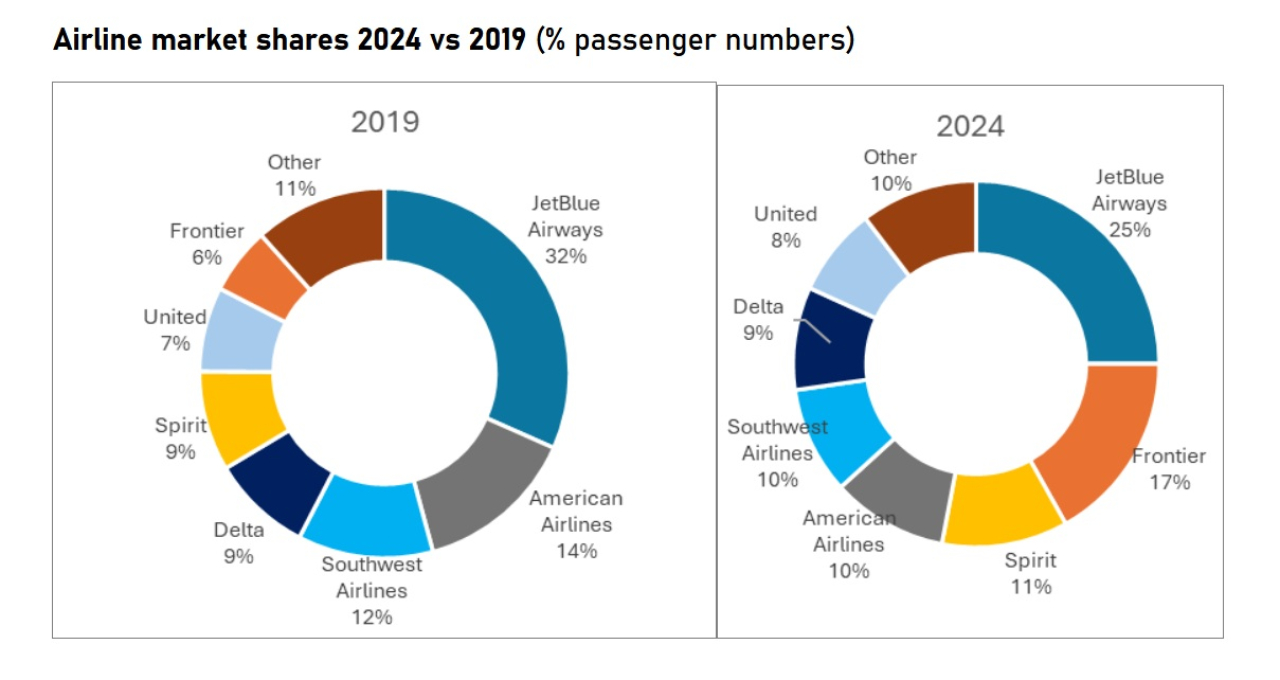
In line with this, airline development also took off. JetBlue, already the market leader, added new frequencies and expanded its San Juan hub. While the airline has contributed to growth with around 10% more passengers carried in 2024 versus 2019, the biggest gains came from Frontier and Spirit, which are now the second and third largest airlines (see chart above), stimulating demand with affordable fares and opening new markets.
In addition, Iberia, Copa, and Colombian carriers have contributed to international diversification in recent years, though at a smaller scale. For example, Iberia is set to offer an 11-weekly frequency to Madrid from October, which will drive more European tourism to Puerto Rico.
Puerto Rico also benefited from federal recovery funds, first after Hurricane Maria and later during the pandemic. This injected liquidity into the economy, with reconstruction efforts generating business travel, while a stronger hospitality sector reinforced the tourism rebound.
For investors ASUR and PSP, the early years with little traffic growth underscored the importance of resilience and holding onto a long-term vision. The modernization investments undertaken during that early period paid off during the subsequent surge. Now, with tourism flourishing, a diversified airline mix, and strong U.S. demand, SJU has become an example of how private airport management can unlock value despite external headwinds.