
Login/Register
IBA: China’s Comac Starts to Eat Into Airbus and Boeing Duopoly
Kevin Rozario
September 3, 2025

China's C919 jet went into commercial operation in mid-2023.
© Comac/中国商飞公司新闻中心
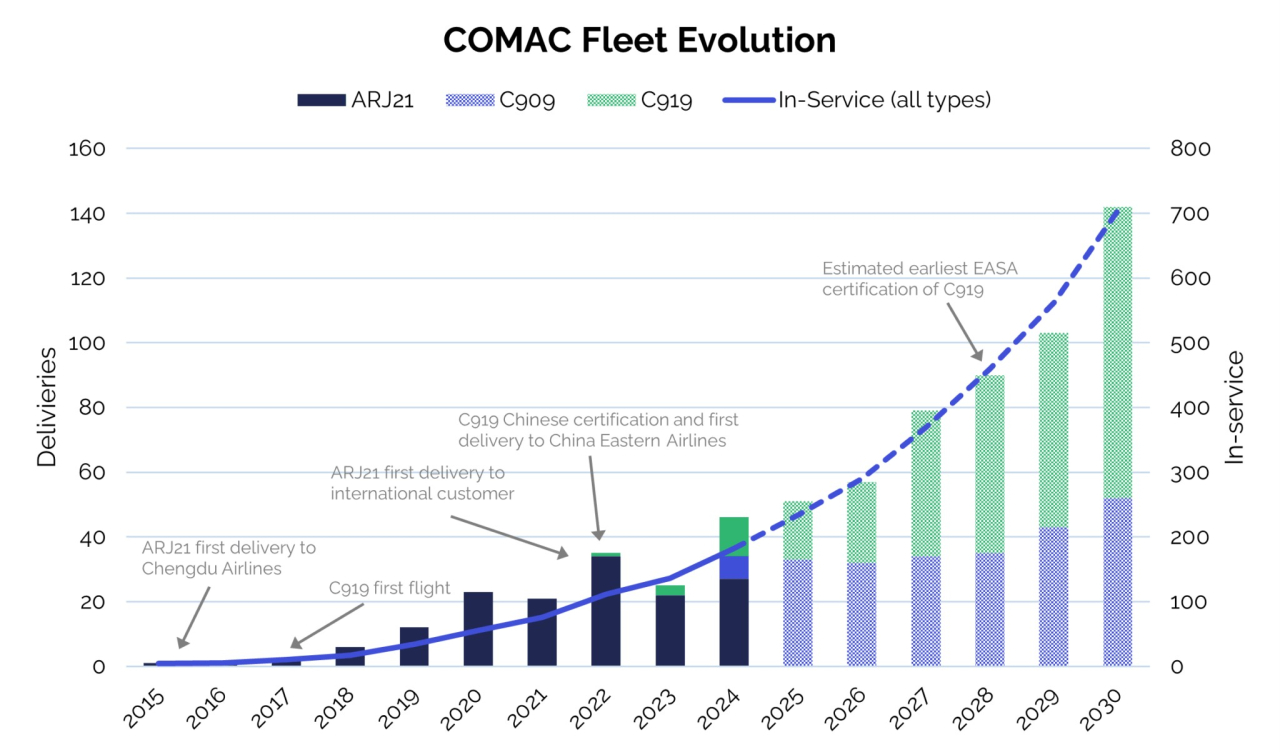
The Commercial Aircraft Corporation of China (Comac) is stepping up its aircraft deliveries in the coming years, with a rate of 145 jets per year by 2030, according to a forecast from independent aviation market intelligence and advisory firm, IBA. By then, it will be a contender—versus Airbus and Boeing—in its home narrowbody market.
The increase means that the Chinese company will more than triple its rate of deliveries, which IBA says, “marks steady progress in China’s ambition to establish an independent commercial aviation industry.”
According to data from IBA’s Insight platform, Comac is on track to deliver 50 aircraft this year, rising to 57 in 2026, 79 in 2027, and around 90 in 2028, before reaching 145 by the end of the decade. Deliveries will be dominated by its C919 narrowbody program, supported by continued output of the C909 regional jet, plus the development of the future C929 widebody.
© IBA
By 2030, IBA forecasts Comac will have secured around 65% of new narrow-body deliveries to Chinese operators, adding some excitement for plane-spotters at airports, especially in Asia-Pacific. However, they will still need to be eagle-eyed as that percentage will equate to just 7% of the total in-service fleet when legacy Airbus and Boeing types are included.
Globally, the C919 and C909 will remain a niche player at approximately 2% of the global fleet in 2030 (see pie chart below). Nevertheless, IBA noted: “This is a clear start of the breaking of the Airbus and Boeing duopoly.”
Insight data from IBA show Comac’s in-service fleet reached 182 aircraft by August 2025, concentrated among China Southern, Air China, and China Eastern—with smaller allocations at Chengdu Airlines, China Express, VietJet, and Lao Airlines.

© IBA
Exposure to Supply Chain Risks Exist
Despite the progress, challenges remain for Comac. The July 2025 resumption of U.S. export licenses for the CFM LEAP-1C and GE CF34-10A engines stabilized production, but the manufacturer is still reliant on imported propulsion and avionics. This leaves Comac exposed to supply chain and geopolitical risks. IBA said: “Stockpiled components offer only short-term security, while the CJ-1000A domestic engine is still years from commercial readiness.”
Certification is another hurdle, as the C919 has only been in service since 2023. IBA says it is unlikely to gain EASA validation before 2028, which will limit sales outside China. In the meantime, Comac is focusing on domestic operations and selective regional placements, giving it time to fine-tune its products and build credibility before going global.
Reliability metrics are also improving as the average daily utilization of the C909 has risen to 3.4 hours, up from under 1 hour in 2018, while the C919 has reached 2.6 hours per day since entry into service. Both remain below the narrowbody benchmark of seven hours but are expected to climb as maintenance networks and operator confidence grow.
IBA anticipates that while Comac will not rival the scale of Airbus or Boeing this decade, its trajectory signals the emergence of a credible multi-sector competitor, with potential implications for airports. Political support, strong domestic demand, and incremental progress on international certification are positioning Comac to play a measured, yet increasingly significant, role in global commercial aviation.
More of IBA’s insights on Comac can be found here.