
Login/Register
How Kazakhstan’s Liberalization Unleashed LCC Air Travel
Dion Zumbrink
March 25, 2026

Kazakhstan's liberalization offers a blueprint for other developing markets.
© ACI Europe
Kazakhstan’s aviation market has undergone a remarkable transformation over the past decade, transitioning from a relatively closed, capacity-constrained system into one of the fastest-growing air transport markets globally. Passenger traffic at the country’s airports has nearly doubled since 2018, with growth accelerating significantly after 2021.
Kazakhstan’s aviation development has been driven not only by economic growth and rising incomes, but more importantly by structural reforms in market access and the rapid expansion of low-cost carriers (LCCs). The combination of liberalization and low-cost capacity has been the driver behind the strong increase in air traffic and offers a model for other emerging aviation markets, such as those in Africa, where this transformation is yet to materialize at scale.
Kazakhstan’s Aviation Industry
The underlying fundamentals for aviation growth were strong, given that the middle class expanded from 26% of the population in 2006 to 67% by 2021. But historically, Kazakhstan’s air transport market was relatively concentrated, with limited competition and high fares, particularly on domestic routes.
A major turning point came with Kazakhstan’s air transport liberalization, particularly the introduction of the open skies policy at selected airports starting in 2017. This enabled the emergence of FlyArystan, launched in 2019 as a low-cost subsidiary of Air Astana. As can be seen below, following these events, somewhat delayed by the COVID19 pandemic, air traffic surged between 2021 and 2025. With 7.1% growth recorded last year, the trend continues apace.
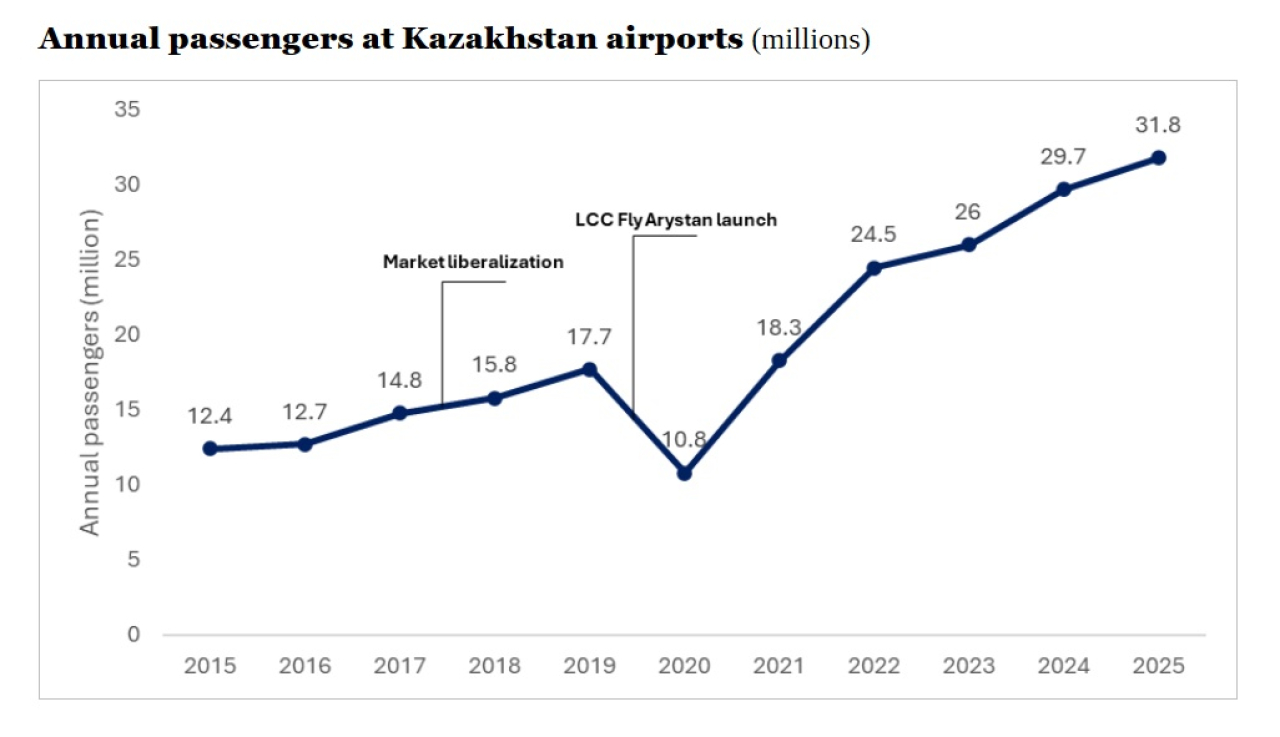
Traffic growth has exploded since the COVID19 era.
© Dion Zumbrink
Liberalization of the Market
The open skies policy was expanded after its introduction in 2017. Under the new regime, restrictions on frequencies and capacity were removed, multiple airlines from the same country were allowed to operate routes, and airlines were given greater freedom in pricing. In addition, Kazakhstan granted fifth-freedom traffic rights on certain routes, allowing foreign airlines to carry passengers between Kazakhstan and a third country as part of a multi-sector route.
By lowering barriers to entry, the policy enabled more foreign airlines to enter the market and existing airlines to expand frequencies and destinations. Increased competition led to lower average fares and improved connectivity, both internationally and regionally. Importantly, liberalization also created the regulatory environment necessary for the development of LCCs, which require pricing freedom, flexible slot usage, and the ability to open new routes quickly.
Development of Low-Cost Carriers
The second major driver of Kazakhstan’s aviation growth has been the emergence and expansion of LCCs, most notably FlyArystan. The airline introduced a true low-cost model to the domestic market, significantly reducing fares and making air travel accessible to a much larger portion of the population.
The airline now operates a fleet of 28 aircraft (forecast to grow to 30 by 2029) and carried around 9 million passengers in 2025. It has a share of 40% in the domestic market, while international expansion is still moderate, with the airlines holding a 6% market share.

FlyArystan has taken a large share of domestic air travel.
© Dion Zumbrink
The impact of LCCs on passenger traffic is well-documented globally. Lower fares stimulate new demand rather than simply diverting passengers from other airlines. In Kazakhstan, this effect was particularly strong because the market was previously underserved and price sensitive.
LCCs also expanded international point-to-point routes, particularly to nearby countries such as Turkey, the United Arab Emirates, and Central Asia. This further stimulated outbound leisure travel and visiting friends and relatives (VFR) traffic, both of which are highly price sensitive and therefore responsive to low-cost capacity.
Other Growth Drivers
While liberalization and LCCs were the primary thrust, several additional factors supported aviation growth in Kazakhstan. Airport infrastructure investments increased capacity at major airports such as Almaty and Astana, enabling airlines to expand operations.
Economic growth and rising disposable income also contributed to increased travel demand. In addition, Kazakhstan’s geographic position between Europe and Asia provides long-term potential for transfer traffic and network development.
Another important factor has been the expansion of international tourism and business travel. Visa facilitation and increased international connectivity have made Kazakhstan more accessible to foreign visitors, contributing to international passenger growth. With all of these supply, demand, and policy factors in place, any under-performing market can look to Kazakhstan for a blueprint on achieving similar growth.