
Login/Register
Chile’s Pioneering PPPs: Thirty Years & USD28bn Later
Rodolfo Echeverria
May 13, 2026

Santiago's Arturo Merino Benítez Airport in Chile.
© Soc. Concesionaria Nuevo Pudahuel
Chile has one of Latin America’s most mature public-private partnership (PPP) systems for transport infrastructure. The country’s concession model has operated for around 30 years and has awarded more than 100 projects for more than USD$28 billion. The system is used across roads, hospitals, prisons, public buildings, water infrastructure, and airports.
Airport concessions are central to Chile’s connectivity because the country’s long and narrow geography makes air transport essential for national integration, tourism, mining, southern regional connectivity, and international access through Santiago. The airport concession model combines state ownership of infrastructure with private-sector participation in financing, expansion, operation, and maintenance under BOT (build, operate, and transfer) or DBOT (design, build, operate, and transfer) structures.
Institutional Framework & Governance
Chile’s airport concession system sits mainly under the Ministry of Public Works (MOP) through the Dirección General de Concesiones (DGC). It also requires coordination with aviation-specific institutions such as Dirección de Aeropuertos (DAP), Junta de Aeronáutica Civil (JAC), and Dirección General de Aeronáutica Civil (DGAC).
The governance flow breaks down as follows:
Ministry of Public Works—Political and ministerial authority for public infrastructure concessions
Consejo de Concesiones—This advisory body within MOP communicates proposed infrastructure and concession modalities and has a decision-making role on public-interest recommendations for private initiatives
DGC—Manages PPP public works concessions including scheduling tenders, proposing tender terms, preparing oversight rules, proposing contract amendments, and studying private concession initiatives
DAP—MOP’s airport infrastructure unit is responsible for the development and maintenance of Chile’s airport infrastructure, with a mission to contribute to connectivity and economic and social development
JAC—This civil aviation policy authority directs civil aviation in Chile through public policies that promote civil aviation and air transport development
DGAC—Responsible for aviation operations, the body regulates, controls, and supervises aviation activity and aeronautical personnel, providing air navigation, aviation safety, aviation security, and meteorological services.
Market Overview & History
Chile’s concession system is governed by Decree 900 of 1996, issued by MOP, and the Concessions Regulations, MOP Supreme Decree 956 of 1997. The framework allows public, national, or international tenders, with pre-qualification when projects are large, complex, or expensive.
The investor guide describes Chile’s concession system as a pioneer in environmental management and planning, supporting sustainable infrastructure development. It also states that concession contracts are typically BOT or DBOT. At the end of the concession term, the successful bidder transfers the public works back to the state in adequate condition for future re-tendering.

© Rodolfo E. Echeverría
For airports, the model normally applies to existing public airport infrastructure that is re-tendered for expansion, modernization, and operation. For example, DGC specifically identifies airports as part of the “construction and operation” category, where public works are already operating but tendered again to improve infrastructure and service.
Chile’s Variable Concession Model, PVR & Risk
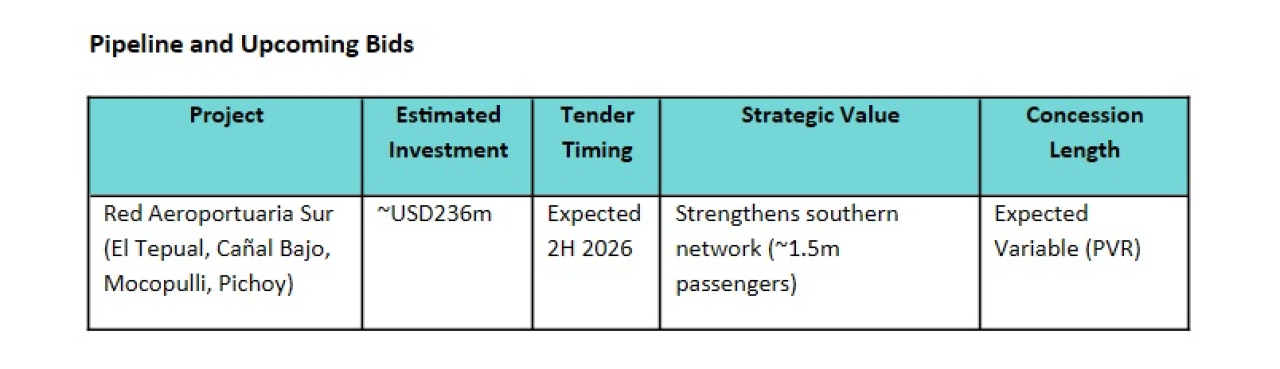
A distinctive feature of Chile’s infrastructure concession system—(find the latest contracts here)—is the use, in some cases, of a variable concession term based on the Present Value of Revenues (PVR). Under this model, the concession does not necessarily end on a fixed calendar date. Instead, the contract can end when the concessionaire reaches a pre-agreed PVR, subject to any maximum term established in the tender documents.
This mechanism reduces demand risk because traffic and revenue uncertainty are partially absorbed through time. If demand is lower than expected, the concession may last longer until the target PVR is reached. If demand is stronger than expected, the concession may end earlier. This creates a more balanced risk allocation between the State and the private concessionaire.

© Rodolfo E. Echeverría
For investors, the PVR model is relevant because it enhances bankability. It does not eliminate demand risk, but it mitigates it. For the state, it reduces the need for direct guarantees while preserving competitive tendering and ensuring the asset's eventual transfer.
However, the model is not always aligned with the perspective of long-term airport operators, particularly those focused on sustainable traffic development and value creation beyond the construction phase. While infrastructure investors and contractors may benefit from the risk mitigation, airport operators often perceive certain limitations. These include, for example, reduced upside capture in non-aeronautical revenue and weaker incentives to maximize traffic development over the long term.
In this sense, the model can be seen as initially optimized for financial robustness and construction-led participation, rather than for long-term operational value maximization. This does not diminish its importance; it highlights an opportunity for evolution.
© Rodolfo E. Echeverría
Chile’s PVR-based concession framework remains a unique and sophisticated mechanism. With further refinement, it could move toward a more balanced structure to better align incentives for all stakeholders. This is particularly relevant if the objective is to attract experienced airport operators into regional airport programs, operators capable of driving sustainable growth, enhancing non-aeronautical performance, and implementing ESG-driven management.
A more balanced, win-win approach would strengthen the model’s ability not only to finance infrastructure efficiently, but also to unlock the full operational and commercial potential of Chile’s airport network beyond its primary hub.