
Login/Register
Albania’s Ascent and Tirana Airport’s Surging Traffic
Kevin Rozario
January 7, 2026
© TIA
Tirana International Airport (TIA) ended 2025 just shy of 12 million passengers. The figure is significantly higher than the 3.3 million recorded in 2019, and marks a meteoric rise for Albania’s primary gateway.
From the early 1990s, the country has been evolving from an isolated communist state into an emerging European tourism destination, with the airport also benefiting from a change in management. In December 2020, Albania’s privately owned Kastrati Group—a diversified player in energy and infrastructure, among other sectors—took on the TIA concession and has subsequently developed a thriving airport in the Balkan Peninsula.
From January to August 2025, versus the same period in 2019, TIA was, by far, the fastest growing airport in Europe at +253%, well ahead of the +90% seen at second-placed Chisinau (KIV) in Moldova, which borders Ukraine. A major contributor to TIA’s rise has been its connectivity: the airport now operates more than 120 direct routes.
Speaking to airportIR in a recent podcast, Piervittorio Farabbi, Chief Operating Officer of TIA since April 2023, said: “The airport has grown at a pace that I have never seen anywhere else.” It helped that Kastrati had big ambitions for TIA, underpinned by strong capital investment “in a market that was totally untapped,” according to Farabbi.
The early implementation of a CAPEX plan has served TIA well since the pandemic, as the traffic figures show. Kastrati Group invested around EUR100 million (USD118 million) in the first three years, tripling the terminal space and increasing both capacity and quality. Approximately 15,000 square meters were added to the arrivals area while six new aircraft parking stands took the total to 29.
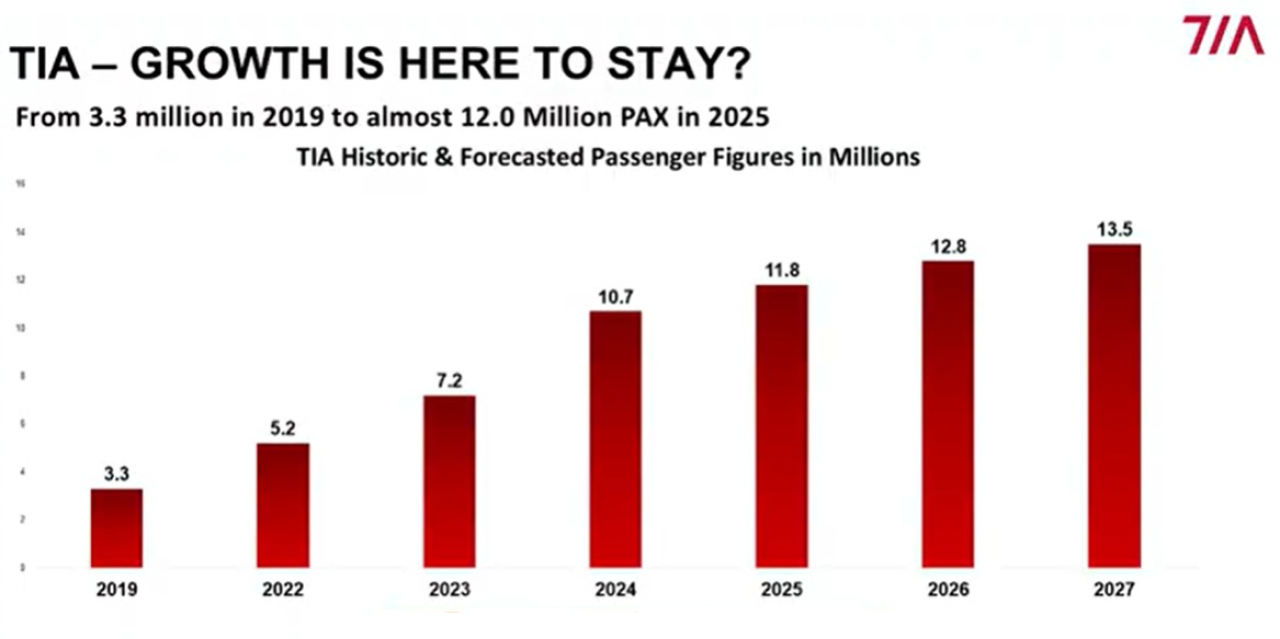
TIA's forecast growth to 2027.
© TIA

Piervittorio Farabbi: “The airport has grown at a pace that I have never seen anywhere else.”
Tirana’s Next Steps
Now, a masterplanning exercise is underway to optimize the rest of the concession, which runs until 2040. “We have just engaged IATA to provide us with forecasts, and we will soon look for an advisor,” said Farabbi. Another terminal or even a second runway may be the outcome.
Tourism to Albania—bordered by Montenegro, Kosovo, North Macedonia, and Greece—has soared since 2020 and is on a steeper upward trajectory versus the pre-pandemic trend, which peaked at 6.2 million international arrivals in 2019. In 2024, that figure hit 11.5 million, and between January and October 2025, foreign tourist arrivals rose +7% to 11.1 million. These are impressive numbers for a country of just 2.8 million people.
For TIA, 45% of traffic is to-and-from Italy, where there is a significant Albanian diaspora, and another 15% to-and-from Germany. With a structured tourism push as part of a formal National Tourism Strategy (2024–2030), Albania is becoming a more diversified visitor destination. Tourism contributed over 8% of the country’s GDP in 2024 and has become central to its economic development.
The NTS is targeting a +138% increase in overnight stays and a fourfold rise in government tourism revenue by 2030. This will be reflected in more demand on TIA’s resources, hence the need for a new masterplan to manage what could be exponential traffic growth in the coming years.
[Listen to the podcast conversation between Piervittorio Farabbi, Chief Operating Officer of TIA, and Curtis Grad, President and CEO of Modalis Infrastructure Partners, for the full background to Tirana’s revitalization and Albania’s continuing development.]