
Login/Register
Poland on Track for a Bright 2026
Dion Zumbrink
December 24, 2025

Warsaw has become a bustling European capital city.
© Kamil Gliwinski / Unsplash
Poland’s aviation sector has long shown strong fundamentals: an expanding economy, strategic positioning between Western Europe and fast-growing eastern markets, a rising middle class, and diaspora travel demand. The country is delivering on these, closing 2025 with expected double-digit traffic growth and a bright outlook for 2026.
European Union forecasts project Poland will have the second-strongest GDP growth in 2026 with 3.5%, behind Malta. Airline networks are also widening as Wizz Air and LOT increase flights, and major airports embark on expansion cycles, while preparations for the giant CPK hub near Warsaw continue.
Record Passengers
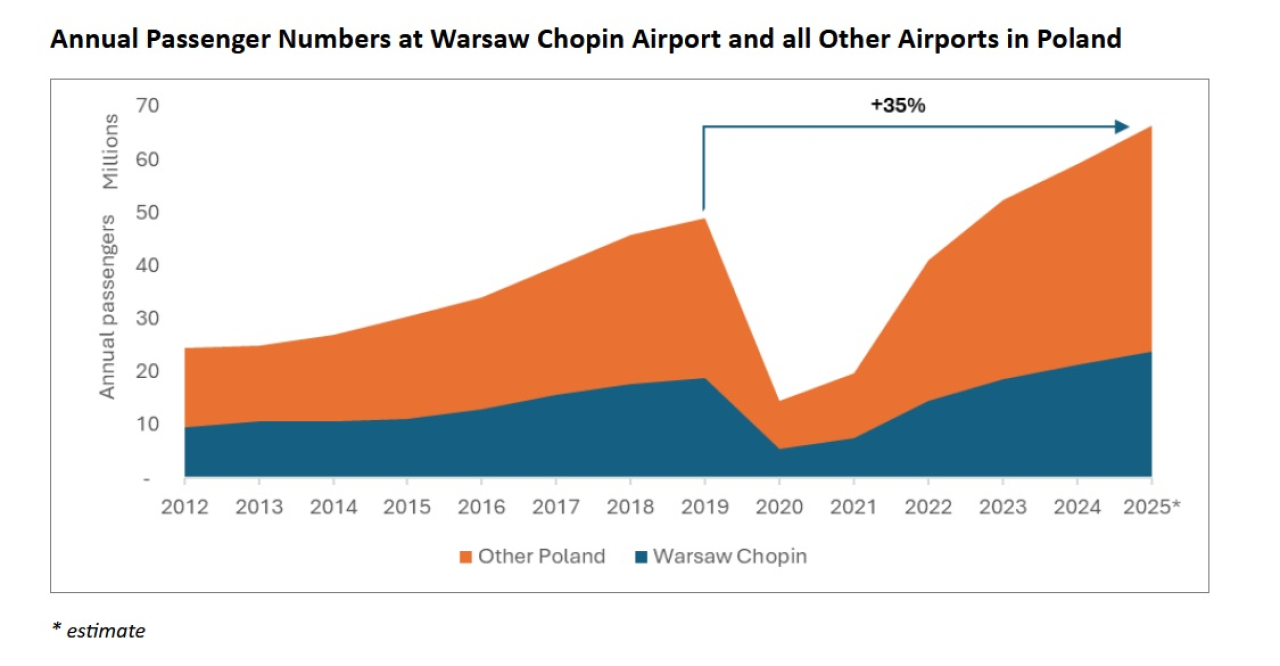
Mid-year updates suggest that 12% minimum traffic growth is likely this year, bringing Poland’s air passenger numbers above 65 million, a 35% hike over the 2019 volume. Warsaw Chopin Airport (WAW) is expected to handle more than 23 million passengers this year, which is close to its design capacity of 24 million.
© Dion Zumbrink
Most traffic is international as the domestic market is relatively small, with just seven million passengers in 2024. Warsaw, the capital, is centrally located, and road and rail connections are good, providing competitive alternatives to air travel.
The country is dominated by three airlines which handle 80% of the international market. Ryanair is the largest with a 35% share, followed by Wizz Air. Polish flag carrier LOT operates 17% of the international market.

© Dion Zumbrink
Airline Growth Plans
Ryanair confirmed its commitment to the Polish market in 2025 by increasing capacity by 5% and basing three new aircraft in the country, reaching a total of 44. This summer, the low-cost carrier confirmed expansion plans at Warsaw’s Modlin Airport (WMI) to five million passengers by 2030 by doubling the number of aircraft based there to eight.
Poland is also a core growth market for Wizz Air. Recent announcements indicate the LCC will deploy roughly 40 new routes to and from Poland between December 2025 and summer 2026. This month, Wizz Air opened a new base at WMI with two A321NEO aircraft.
LOT wants to position itself as the leading full-service carrier in Central and Eastern Europe. It has ambitions to expand its network across Europe, strengthen long-haul connectivity, and become a major European hub carrier when the country’s planned mega-hub Central Communication Port (CPK) opens.
In June 2025, LOT placed a firm order for 40 new Airbus A220 jets, to be delivered from 2027 onwards. The order includes an option to expand to 84 units. Meanwhile, 2026 expansion will continue with a new route to San Francisco and the lease of two additional Boeing 787-8 Dreamliners.
Airports Expansion Plans
WAW is Poland’s largest airport, serving as a hub for LOT and the main access point to the country. In addition, all major cities have airports with significant LCC capacity and a broad network across Europe.

© Dion Zumbrink
Multiple airport expansion and modernisation projects also indicate the dynamism of the Polish market. Among the most significant are:
- Warsaw Chopin: Optimisation to provide additional capacity ahead of future consolidation into CPK.
- Kraków: A multi-phase terminal expansion and apron enlargement. A terminal expansion of 44,500 square meters was tendered in 2025, increasing capacity to 16 million annually. The full masterplan envisages a capability for 19 million passengers by 2031.
- Gdańsk: Opened a new pier in 2022 and continues its expansion with extra apron space and an airport city development.
- Katowice: Operates close to saturation during summer peaks. A USD500 million investment plan from 2024 to 2032 includes a new 49,000 square metercentral passenger terminal.
- Central Communication Port (CPK): This greenfield hub is located 37km west of Warsaw and is designed with an initial capacity of 40 million passengers per year, scalable in later phases up to 65 million and beyond. It includes a 400,000 square meter modular terminal and integrated rail infrastructure that will connect the airport to Poland’s major cities. The airport is set to start operations in 2032.
Taken together, these airline and airport investments underscore a market entering a new growth phase. Poland is no longer simply catching up with Western Europe; it is shaping its own competitive position in the region, backed by strong economic momentum and a clear national vision for connectivity.