
Login/Register
Ethiopia Sets New Benchmark for African Airports
Kevin Rozario
January 28, 2026

Bishoftu International will eventually be a four-runway airport.
© DAR
On January 10, Ethiopia broke ground on a new USD12.5 billion airport, Bishoftu International (BIA), a gateway that is set to become Africa’s largest aviation hub and ultimately designed to serve 110 million passengers annually.
The country’s Prime Minister, Abiy Ahmed, said at the ceremony that the futuristic airport—one of the most ambitious aviation infrastructure projects in Africa’s history—aligns with “our national economic reforms, industrialization agenda, and long-term aviation strategy.”
State-owned Ethiopian Airlines, founded in 1945, has long had a network strategy for Africa and key international destinations that has driven speedy growth. It has been so successful that the carrier, which will run the new BIA, has become, by far, Africa’s busiest airline. According to Q3 2025 data estimates from OAG and published by the African Airlines Association (AFRAA), Ethiopian Airlines comfortably outperformed Egyptair in terms of passenger traffic (see chart below).

© AFRAA/OAG
In airport terms, OAG data for Q3 2025 also show that Addis Ababa’s Bole Airport (ADD) already had a significant lead over both Cairo and Johannesburg. And with BIA on the drawing board, Ethiopian Airlines wants to take advantage of IATA’s forecast that Africa’s aviation market is projected to double by 2044.
Bishoftu International will further entrench Ethiopia as the heart of Africa’s air transport network—and should elevate it to a major global hub. Located about 40km south of the capital, Addis Ababa, the airport’s first phase will deliver a 660,000 square-meter terminal capable of handling 60 million passengers annually, with future phases expanding capacity to the final 110 million. Four runways are envisaged with parking for 270 aircraft.
A Fourfold Increase
This scale makes BIA more than four times larger than Addis Ababa’s existing ADD, which is now reaching its operational capacity. The project is led by DAR (Dar Al‑Handasah) as the main consultant, with Zaha Hadid Architects (ZHA) responsible for terminal architecture, interior design, and functional planning.
BIA’s design by ZHA is tailored to Ethiopian Airlines’ ambitious long‑term growth strategy, with up to 80% of passengers expected to be transit travelers.
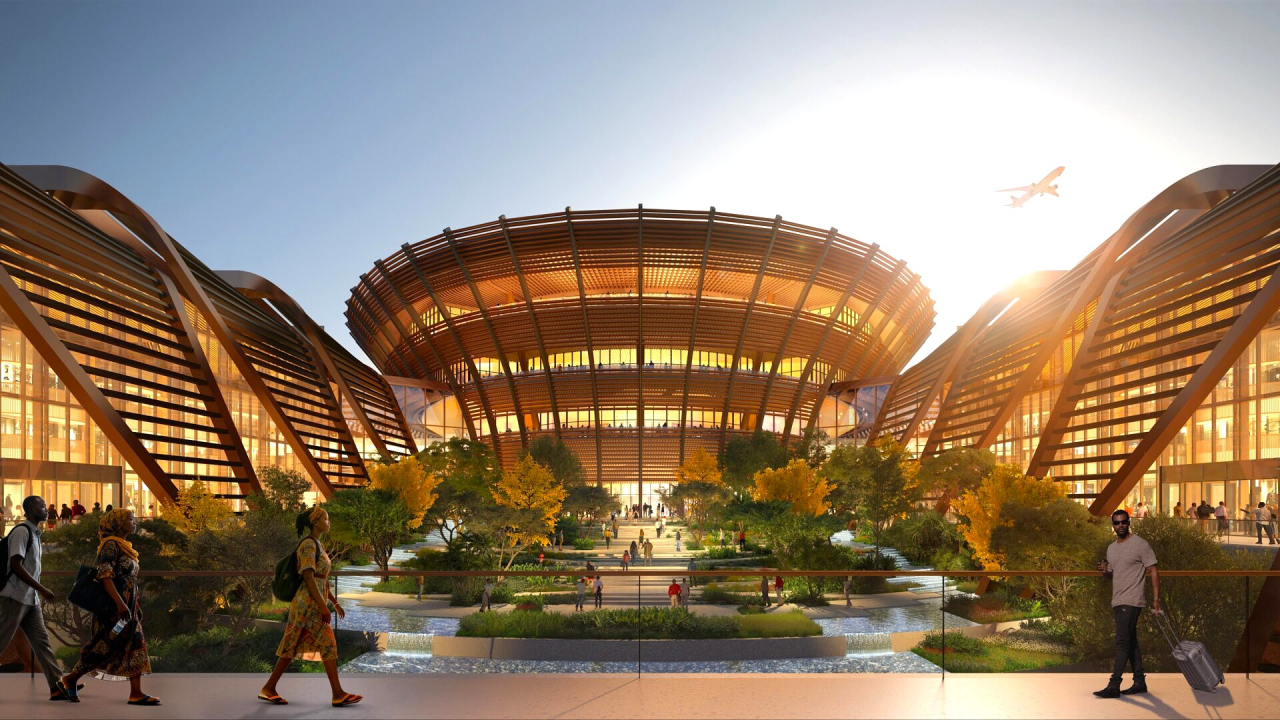
Lush gardens will be a key feature of Bishoftu Airport.
© Render by X Universe / ZHA
This means the terminal is being built around efficient transfers, short walking distances, and a central spine that links all the major facilities. This spine is said to be inspired by the nearby Great Rift Valley. It connects the terminal’s piers and creates, as ZHA calls it, “a clear, intuitive circulation system.” Each pier features a distinct interior material palette reflecting Ethiopia’s diverse regions, embedding cultural identity into the architecture.
The airport’s elevation—almost 400 meters lower than ADD—combined with longer runways, is expected to significantly improve aircraft performance. Ethiopian Airlines will be able to operate at higher maximum take‑off weights, enabling longer-range, non‑stop flights with improved fuel efficiency. This is central to the airline’s Vision 2035 strategy, which aims to expand its global reach across passenger, cargo, and MRO services.
Opening Set For 2030
BIA’s phased construction should result in an initial opening by 2030. This phase will include two independent parallel Code 4E runways and the main terminal. The construction strategy uses modular fabrication for efficiency and flexibility, with an emphasis on locally sourced or recycled materials.
The airport will operate 24 hours a day without curfews, and its development includes an integrated ‘airport city’ complex featuring mixed‑use buildings that will support a local population of around 80,000 people. This component is intended to stimulate economic growth, create jobs, and anchor a new regional transport network.

© Render by X Universe / ZHA
As with most new builds, sustainability is central to the design. The terminal aims for LEED Gold certification and incorporates natural ventilation, solar shading, and semi‑open spaces that take advantage of the region’s temperate highland climate. Outdoor courtyards and gardens provide relaxation areas for transit passengers.
Environmental management is integrated into the infrastructure. Storm water from runways, taxiways, aprons, and building roofs will be channeled into wetlands and bioswales for reuse and to support biodiversity. Photovoltaic arrays across the site will generate on‑site renewable energy, and landscaping will use native, drought‑resistant plants, including transplanted trees. This will create both public parks in the landside areas and lush airside gardens.
Connectivity with ADD and to central Addis Ababa is also part of the infrastructure mix. A high‑speed rail link will connect the capital and Bole Airport, forming the backbone of a new regional transport system.