
Login/Register
U.S. Airports Lose Ground as Asian Hubs Surge in 2025 Rankings
Kevin Rozario
April 15, 2026

Shanghai Pudong Airport saw a double-digit rise in traffic in 2025.
© Avinex
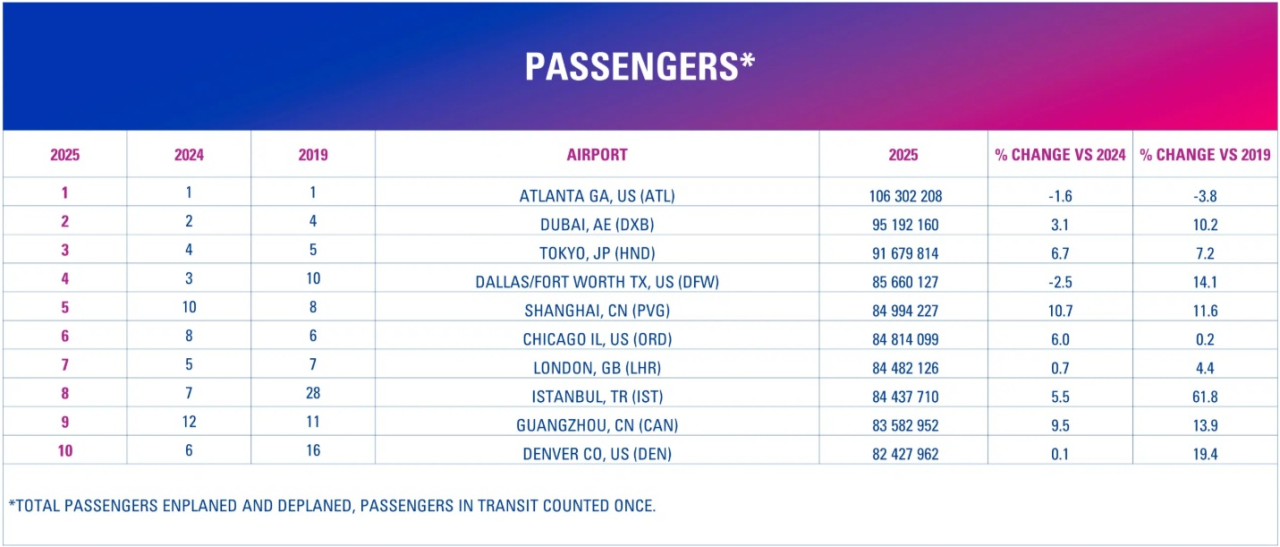
Asian airports have made their presence felt in the 2025 top-10 list of the world’s busiest airports from Airports Council International (ACI) World. The three that made the elite grouping all made ranking and passenger gains, whereas three of the four U.S. airports in the list either saw traffic contract or a positional fall.
While Atlanta’s Hartsfield-Jackson (ATL) retained the top position with 106.3 million passengers, this was down by 1.6% year-over-year. Second-ranked Dubai International (DXB) with 95.2 million passengers grew 3.1%, but Japan’s Haneda (HND)—officially called Tokyo International Airport—grew by 6.7% to hit 91.7 million passengers, moving it into third place from fourth in 2024. This rise was at the expense of Dallas-Forth Worth (DFW), which drifted down from third to fourth as traffic fell by 2.5% to 85.7 million.
The biggest riser in the top 10 was Shanghai Pudong (PVG), which jumped five places to fifth with traffic growing at 10.7% to 85 million, the only gateway to see a double-digit rise. The growth was supported by international traffic recovery at PVG, visa policy easing, and expanded connectivity.
The third Asian airport in the top 10 is also Chinese—Guangzhou Baiyun (CAN)—which rebounded to ninth position, up from 12th last year, as traffic jumped by 9.5% to 83.6 million. The return of Asian gateways reflects a slow-burning return from pre-COVID times, but it indicates an overall stronger travel market in the eastern hemisphere. In 2019, for example, HND was ranked 5th, PVG 8th, and CAN 11th.
Among the remaining two U.S. airports in the top 10, Chicago O’Hare (ORD) grew by a respectable 6% to 84.8 million, moving up two places to sixth, while Denver (DEN) dropped from sixth in 2024 to 10th last year on flat traffic of 82.8 million. The four American airports all have significant domestic passenger shares ranging from 80–95% and therefore are more susceptible to home-market economic headwinds.
ATL easily held its pole position despite a fall in traffic.
© ACI World
Total Global Traffic Reached 9.8 billion
According to the ACI data, in 2025, global total passengers were estimated to have reached 9.8 billion, representing an increase of 3.6% from 2024 or a gain of 7.3% from 2019 (pre-COVID) results. The top 10 airports represented 9% of global passenger traffic.
ACI World, an association that represents airports globally, noted that these gateways all play a critical role in the global air transport system, anchoring connectivity and enabling the efficient movement of people and goods worldwide.
In the context of global aviation in 2025, ACI noted the following:
- A resilient but fragile global economy: Global GDP grew by ~3.0–3.2% in 2025, above expectations but below historical norms, with ongoing risks from trade tensions, protectionism, and policy uncertainty affecting air travel demand
- Lower fuel prices and easing inflation supported demand: Jet fuel prices fell (by ~13% YoY), and inflation eased, boosting purchasing power and sustaining strong passenger demand despite volatility.
- The global recovery was led by international traffic: Global airport traffic rose 3.6% in 2025, driven by international demand and Asia-Pacific recovery, while North American and European hubs neared saturation. Capacity is becoming a key constraint: Growth was increasingly limited by infrastructure and slot constraints in some regions, aircraft delivery backlogs, and air navigation limitations.
- Geopolitics reshaping traffic flows: Airspace closures and conflicts increased flight times and costs, prompting rerouting and shifting traffic toward alternative hubs
- China’s reopening is boosting global hubs: The return of Chinese travel accelerated growth across Asia-Pacific and major hubs, strengthening global connectivity.
ACI World Director General Justin Erbacci said: “We congratulate the world’s busiest airports for managing growing air travel demand amid increasing operational complexity. These hubs support global trade, tourism, and economic growth in their communities and regions. To keep pace with rising demand, governments must prioritize sustained investment in airports and the broader aviation ecosystem.”